
A tax lien lands on your house every January 1, before anyone mails you a single piece of paper. Nothing went wrong there, because that’s how the system works. Under Texas law, a lien attaches to every taxable property on the first day of the tax year. All of this happens months before the appraisal district finishes its math and the collector prints a bill. So by the time a notice about delinquent property taxes reaches you, the claim against your Texas home has been sitting there for a year or more.
I’ve bought houses across Texas from sellers in exactly that spot.
When Do Texas Taxing Units Mail Tax Bills, and What Happens If You’re Late?
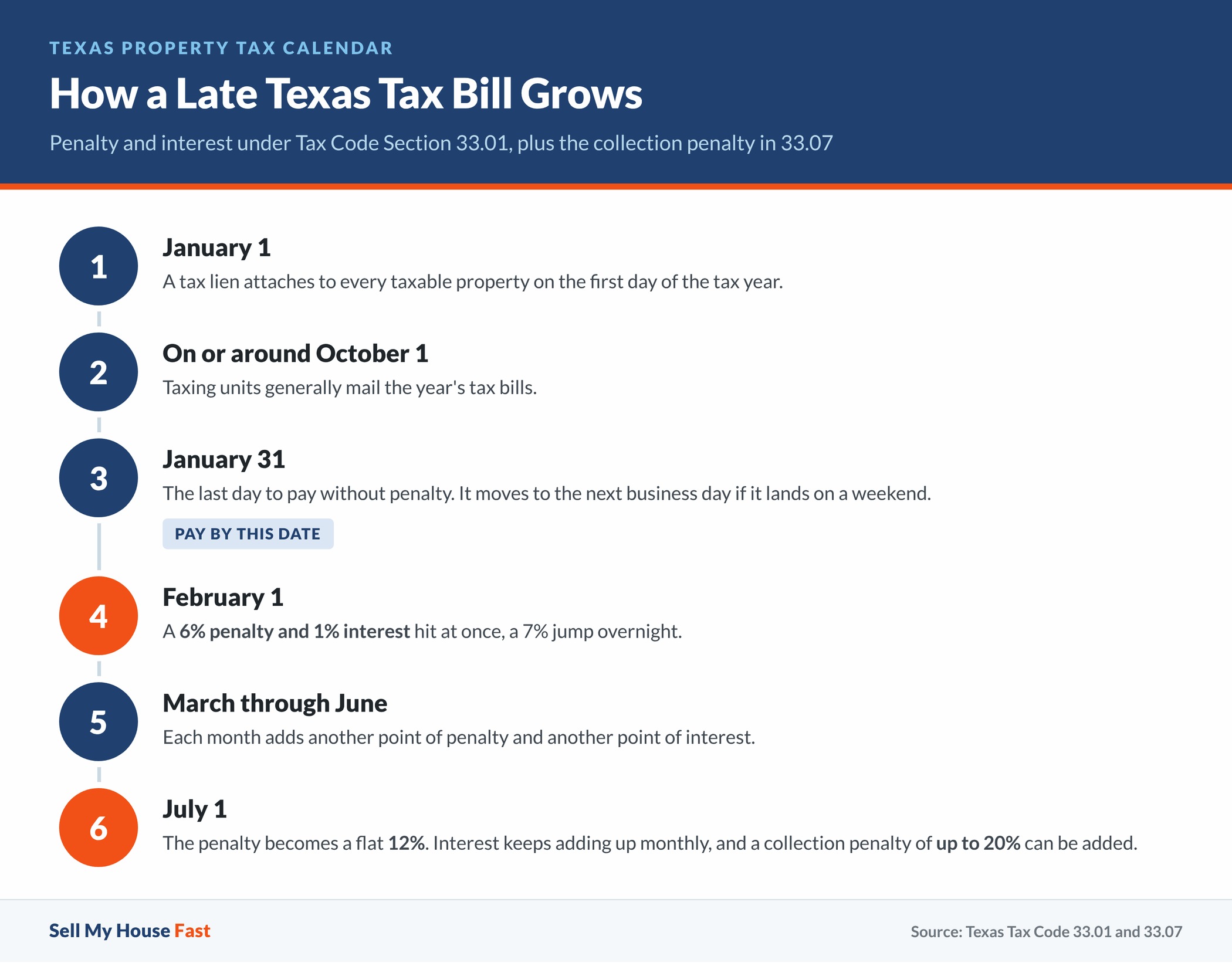
The bill shows up in the fall, and you set it on the counter to handle after the holidays. Your window is shorter than it feels. In Texas, taxing units generally mail bills on or around October 1, and January 31 is the final day to pay without penalty.
Then February 1 arrives.
Under Texas Tax Code Section 33.01, the schedule is set: on February 1, a 6% penalty and 1% interest hit immediately. Overnight, that’s a 7% jump on an account that was merely late the day before. Each month after that adds another point of penalty and another point of interest. Plenty of Texas homeowners stop reading there and assume the worst is over, and it isn’t. On July 1 the penalty becomes a flat 12% of the tax owed, and interest keeps accruing monthly on top. Beyond that, a collection penalty of up to 20% can be added under Section 33.07. It’s the attorney fee your taxing unit tacks on when it hands the file to outside counsel.
One wrinkle worth knowing: the delinquency date shifts when January 31 falls on a weekend, because Texas law pushes the deadline to the next business day. Your county tax assessor-collector can confirm the exact date for your account each year.
Run the math on four annual bills of $4,000 each, all sitting unpaid. The total isn’t $16,000 in delinquent property taxes anymore. It’s that figure plus a stack of penalties and interest on every one of those years, and that’s a floor rather than a ceiling once attorney fees land.
Is There a Deadline to Pay Delinquent Property Taxes Without Penalty in Texas?
An heir in Rowlett called me early last year about a house her mother left her. It carried two years of unpaid taxes and a second mortgage. From Phoenix, she’d been quietly covering that mortgage for almost eleven months. She’d never seen the inside of the garage, which held a 1970s bass boat and about forty boxes of Christmas decorations.
January 31 is the only date that keeps you clean. Past that, there’s no grace window, no five-day cushion and no appeal to a sympathetic clerk at the counter. Travis County’s tax office states plainly that it has no authority to remove penalty and interest, because state law sets them. Other Texas collectors work under that same state law.
Even a payment postmarked February 1 counts as late.
Certain owners get a different track entirely. Homeowners age 65 or older can postpone current and delinquent property taxes on their homes by signing a tax deferral affidavit at their appraisal district office. Disabled homeowners qualify under the same rule, Section 33.06. Once the affidavit is filed, a pending foreclosure sale on the homestead’s tax lien stops. No taxing unit can start or continue a collection lawsuit afterward. The trade-off sits right in the form. Your tax lien stays on the property and keeps accruing interest at 5 percent a year during the deferral. Penalties and interest from before the filing date are preserved. Deferral postpones; it doesn’t erase.
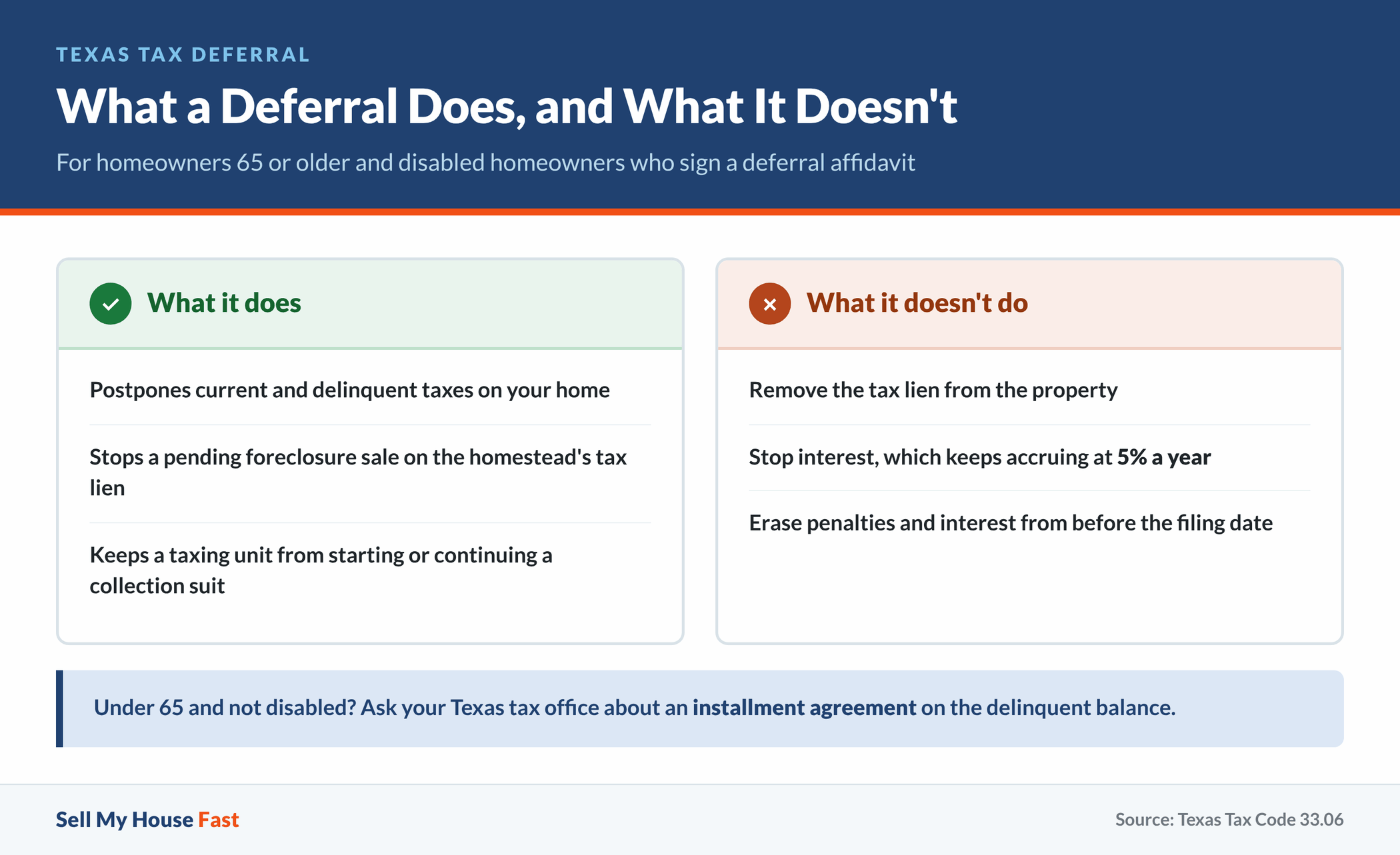
Under 65 and not disabled? Ask your Texas tax office about an installment agreement on the delinquent balance.
How Much Do You Owe? Checking Delinquent Property Taxes in Texas
Guess low on this number and your closing can fall apart at the table. I watched it happen with one seller who said she owed “about eight thousand,” and then the title company pulled the actual payoff. It was half again that much once penalties, interest and collection fees landed across several tax years.
Your county tax assessor-collector’s office keeps an account-by-account search. Most Texas counties post current balances online with a payoff good through a specific month. Call and ask for a payoff quote through your anticipated closing date, not today’s balance, since interest keeps climbing every month while you’re under contract.
Sellers with multiple delinquent property taxes often owe several different taxing units. You might owe the school district, county, city, hospital district and community college. Add a municipal utility district if you’re out in one of the master-planned communities ringing Houston or Fort Worth. Some Texas counties consolidate collection, and others don’t.
Federal tax liens surface the same way, because the IRS files them with the county clerk. Any Texas title company will find everything attached to the house, from judgments and HOA liens to child support liens. It’ll even turn up an old mechanic’s lien from a roofer you paid in cash.
The Texas Comptroller’s office publishes the tax certificate and related property tax forms. Order a tax certificate and you’ll get an official statement of what’s owed on the parcel.
Can You Sell a House in Texas with Delinquent Property Taxes?
You can sell it. The lien travels with the property, not with your intentions. Texas closings resolve liens from the proceeds every day of the week, and nothing in Texas law freezes a house because its taxes are behind.
What changes is the buyer pool. A conventional buyer with a 30-year loan can still close on a house carrying delinquent property taxes, since the title company pays the county at funding. Add a worn-out roof, foundation movement or a house that won’t appraise against a lender’s condition rules, and it’s a different story. Then the financed buyer evaporates.
Timing is the real pressure. Texas Realtors reported on October 20, 2026 that the statewide median price for the third quarter was $333,628, down 0.4% from a year earlier. Active listings rose 2.8%, and closed sales fell 2.4%. Median days on market across the Dallas-Fort Worth-Arlington metro reached 64 in October 2026, up from 51 in June. Add roughly a month of escrow after you accept an offer. Put together, a traditional Texas listing can run three months or more from sign in the yard to money in your hand.
Those numbers work fine when your delinquent property taxes are one year behind and no lawsuit has been filed. They work poorly once a taxing unit has sued to foreclose the lien. Owners in that second group often sell directly to a local buyer like Sell My House Fast, because the title company’s schedule sets the closing date instead of an underwriter’s.
What Happens to Delinquent Property Taxes When You Sell Your Texas Home?
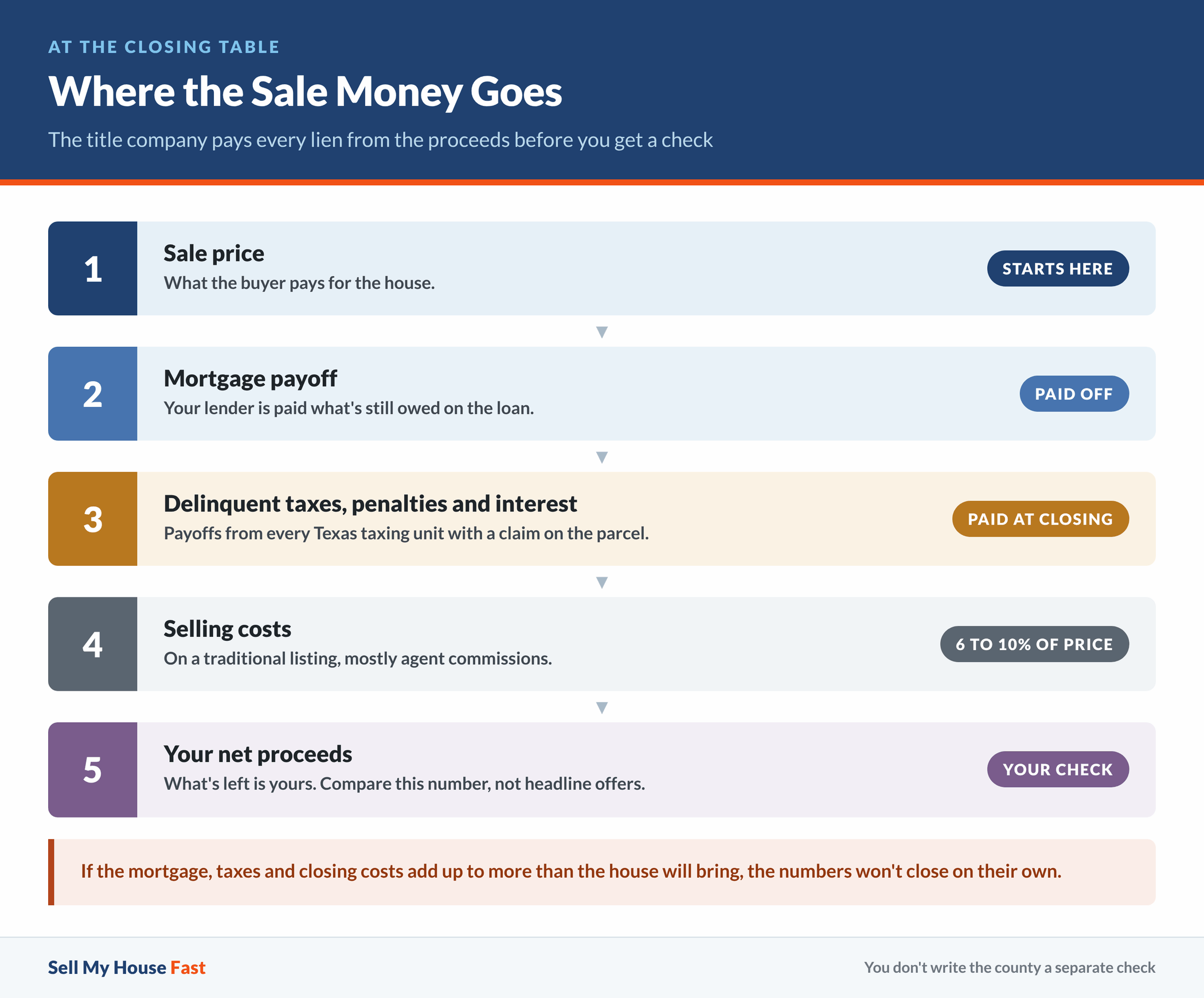
Closing day is where the whole thing unwinds, quietly, in a conference room. The title company requests payoff statements from every Texas taxing unit with a claim against your parcel. Then those amounts come out of the sale proceeds before you’re handed a check. You don’t write anybody a separate check.
Nobody makes a trip to the tax office to pay the county.
Negative equity is the one scenario that genuinely blocks a sale. If your mortgage balance, delinquent property taxes and closing costs add up to more than the house will bring in the current Texas market, the numbers don’t close themselves. On a traditional listing, expect to give up somewhere around 6 to 10 percent of your sale price, and agent commissions are most of that. Selling direct removes the commission line but usually comes in under retail price. So compare net proceeds rather than headline offers.
One detail about old debt matters here: delinquent property taxes in Texas attach as a lien to the real property. They’re also a personal obligation of whoever owned it when the tax accrued, so clearing the lien at closing only resolves the property side.
Your cushion depends on where in Texas you sell. Dallas home prices over the three months ending October 2026 were up 7.8% year over year, with a median sale price of $460,680. Houston went the other direction over that same window, down 5.5% to a median of $330,000. Equity in Oak Cliff may cover a tax balance that would sink a comparable house in Pasadena.
What Documents Do You Need to Sell a House with Delinquent Taxes in Texas?
I once watched a seller find his deed under a 2009 water bill and a coupon book for a car he no longer owned.
Document hunting is less of an ordeal than people fear. Start with your deed. If you can’t find it, your county clerk has a recorded copy for a small fee, so you’re never really stuck. Texas county clerks keep the official real property records, and most of the larger ones let you search online.
Beyond the deed, gather your latest tax statements from each taxing unit, your mortgage payoff information and a government ID matching the name on title. If you inherited the house, the title company will need papers connecting you to the deceased owner. Usually that means a will admitted to probate, letters testamentary, or an affidavit of heirship signed by people who knew the family. Heirship affidavits are common in Texas and workable, though I’ve seen title companies ask for two disinterested witnesses.
Married sellers should know that Texas homestead law requires both spouses to sign the deed on a homestead property, even when only one name appears on title.
Missing paperwork rarely kills a sale with delinquent property taxes. It just slows one down, and a seasoned Texas title company has seen every version of lost, destroyed and never-recorded paperwork.
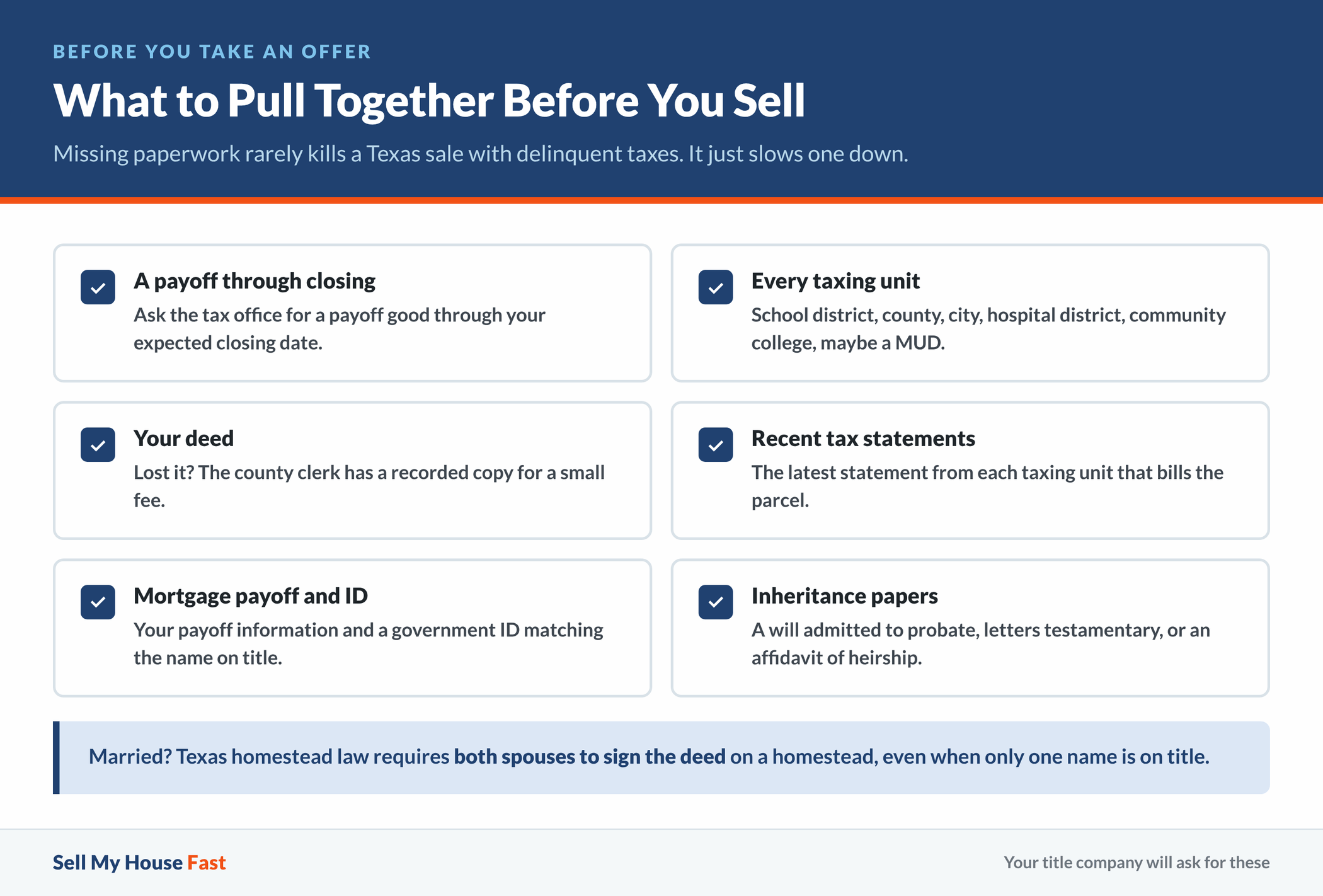
Pull the documents before you take an offer, not after. The Texas Comptroller’s property tax assistance pages list the forms your appraisal district may want if a deferral or exemption is part of your situation.
What Are Your Options If You Can’t Pay Delinquent Property Taxes Before Closing?
Start with the good news. Nobody has to pay delinquent property taxes before closing. The payoff happens at closing, from the proceeds. Most Texas sellers face an equity question, not a cash question.
A property tax loan is the option I’d steer you away from most of the time. Those lenders take an assignment of the tax lien and charge rates that make the county’s penalty schedule look gentle. Seniors on a fixed income who qualify for the deferral should almost never take one out. Asking your Texas tax office about an installment agreement costs nothing and takes one phone call.
Short sales work when the mortgage holder agrees to accept less than the full balance. They’re slow. Your lender will want proof of hardship and a legitimate offer in hand before it agrees.
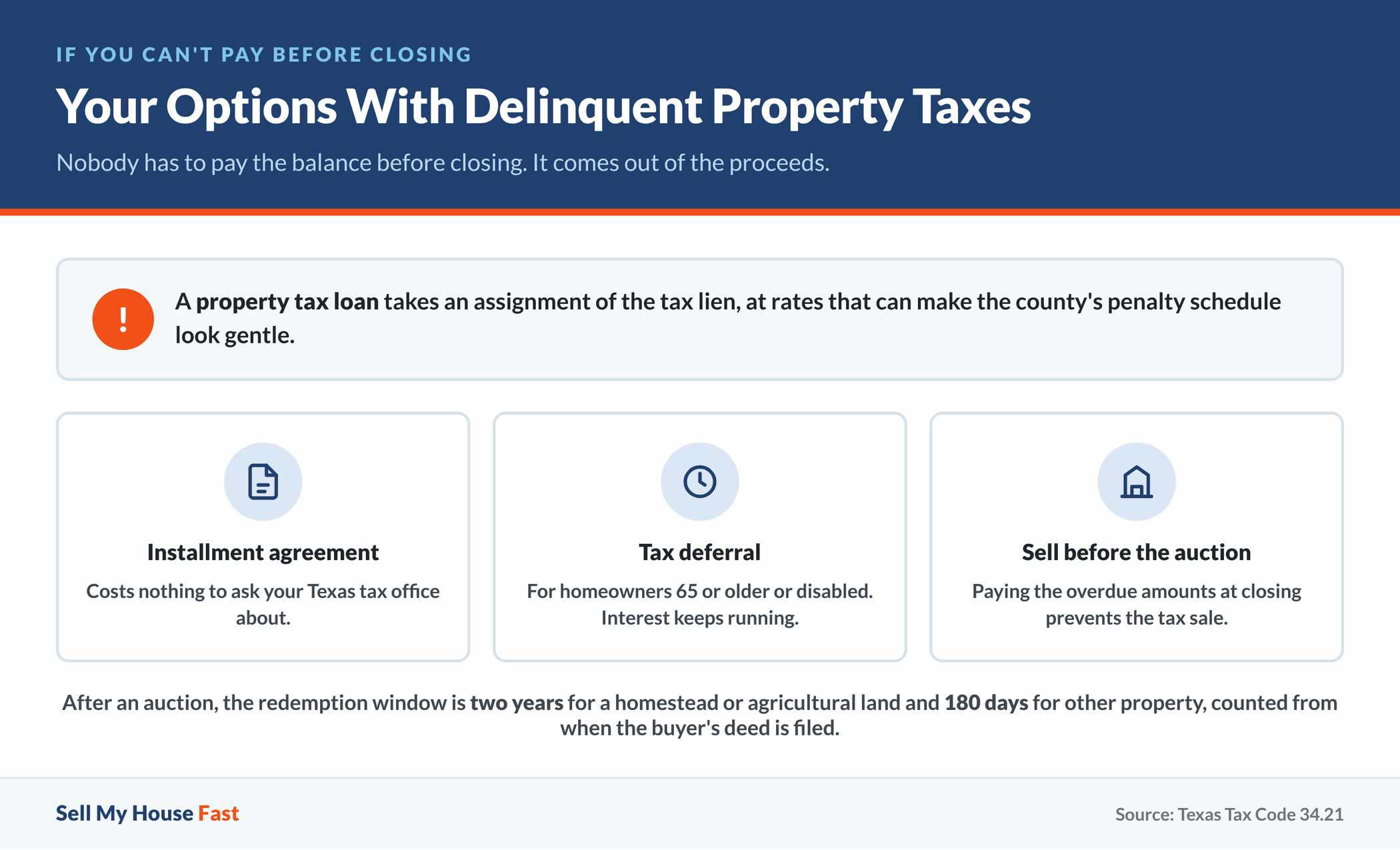
Even after a taxing unit has filed suit, you still have room. Paying off the overdue amounts prevents the tax sale, and a sale that closes before the auction does exactly that. After an auction, Texas gives former owners a statutory window under Tax Code Section 34.21. For a residence homestead or agricultural land the redemption period runs two years, and for other property it’s 180 days. Counting starts when the buyer’s deed is filed for record, not on auction day.
A woman in Georgetown reached out while settling her father’s estate. She was holding three years of delinquent property taxes and a job transfer that gave her five weeks to leave Texas. Sell My House Fast exist for exactly that kind of compressed timeline.
If you’re behind on Texas property taxes and not sure whether to list, defer or sell direct, we’re glad to look at the numbers with you. We’ll tell you plainly which one wins. No pressure, no obligation and no hard feelings if the answer is that you should call a real estate agent instead.
Common Questions About Selling a House with Delinquent Property Taxes in Texas
“This sounds like a pitch to buy my house cheap.” Fair enough. Any direct sale costs you something in price, and anyone who tells you otherwise is selling. What that discount buys is a firm closing date with no repairs and no showings. It also ends penalties that climb every month you wait. Run both numbers.
Does Selling My Texas House Stop the Penalties From Growing?
It does once the sale closes and every tax payoff on the property is wired in full. Until that day, interest keeps adding up each month, so a payoff dated for that day protects you from a short balance. Ask for fresh payoffs if your closing date moves, because an old figure can leave a gap you end up covering yourself.
What Happens to Delinquent Property Taxes on an Inherited House in Texas?
The taxes stay attached to the property as a lien, so they get paid from the sale proceeds at closing like any other delinquent balance. You’ll still have to show you have the right to sell, usually with letters testamentary or an affidavit of heirship. Once that paperwork is in place, the tax payoff works the same way it would for any seller.
What Happens If You Simply Can’t Pay Your Texas Property Taxes?
Penalties and interest accrue month after month, and eventually the taxing unit can sue to foreclose its lien and sell your house at auction on the courthouse steps. Before that point you have real choices: an installment agreement, a deferral if you qualify by age or disability, or selling the house and clearing the balance from proceeds.
How Do You Find Out What Delinquent Property Taxes Are Owed on a Texas Property?
Your county tax assessor-collector keeps searchable account records by owner name and property address, so start there before you call anyone else. Request a payoff good through your expected closing date rather than trusting the current screen balance. When several taxing units bill your parcel separately, ask whether the county collects for all of them or whether you need to contact each one.
Can You Still Sell After a Taxing Unit Files a Delinquent Tax Lawsuit in Texas?
Yes, as long as the sale closes before the auction. A completed sale pays the full delinquent amount, including the extra fees the lawsuit added, and that stops the tax sale. Tell the title company about the suit early so it can get an accurate payoff from the attorney handling the case.
How Long Can Delinquent Property Taxes Go Unpaid in Texas Before Something Happens?
There’s no fixed number of years. Any taxing unit may file suit to foreclose any time after the account goes delinquent. Some Texas collectors move within a year, and others let accounts sit much longer.
What Redemption Rights Does a Texas Owner Have Around a Tax Sale?
Before the auction, you can stop it outright by paying the delinquent amount, and selling the house to pay from proceeds counts. After the auction, the statutory right of redemption described earlier lets a former owner buy the property back from the buyer. The former owner repays the bid plus costs and a premium set by statute. Homestead and agricultural property get the longer window, and most other property gets the short one.
Frequently Asked Questions About Delinquent Property Taxes in Texas
Can I Sell a House in Texas with a Tax Lien on It?
Yes. Tax liens are paid at closing out of the seller’s proceeds, the same way a mortgage payoff is handled. The title company orders a tax certificate and confirms the exact amount owed through the closing date. Then it wires that money to the taxing units before anything reaches you. Once the lien is released, the buyer takes clear title. Equity is the only real obstacle. If the taxes plus any other liens exceed what the house will sell for, you’d need to bring cash to closing or negotiate with the lienholders.
Will a Cash Buyer Pay the Back Taxes for Me?
A cash buyer pays the back taxes out of the sale price, not on top of it. Be skeptical of anyone who frames that as a favor. What matters is the net number on your closing statement after taxes, penalties, interest and any attorney fees come off the top. Ask for that figure in writing before you sign anything.
Does Paying Part of What I Owe Stop the Foreclosure?
A partial payment reduces the balance but doesn’t stop a suit on its own. What stops collection activity is a signed installment agreement with the taxing unit, or full payment. Keep every payment on schedule once you sign an agreement. Defaulting usually accelerates the whole balance, and you may not get a second agreement.
What Happens to the Extra Money If My House Sells at a Tax Auction for More Than I Owe?
Surplus proceeds, often called excess proceeds, are held by the court. The former owner can petition to claim them within the statutory window. This process is slow, and a whole cottage industry tracks these funds and offers to recover them for a cut. You generally don’t need to pay anyone a large percentage to file a claim you can file yourself. Still, the money is far less than you’d have netted from a normal sale.
Can I Get the Penalties and Interest Waived?
Rarely, and only in narrow circumstances, such as a documented error by the taxing unit or a mail failure the statute recognizes. The county has limited discretion here. In a waiver case, write to the tax office and keep copies, but don’t build your plan around relief that may never come.
Is a Deferral the Same as Forgiveness?
No. A tax deferral for an owner who is 65 or older, disabled, or a qualifying disabled veteran postpones collection on a homestead while interest keeps accruing at the statutory rate. The balance doesn’t disappear. It comes due when the owner no longer qualifies or the property changes hands, and then it falls to the estate or the heirs. Deferral buys time, which is exactly what many owners need, but it isn’t a cancellation.
Dallas Homeowners Behind on Texas Property Taxes
This is our home market, and it still gives sellers some room to work. Redfin’s figures for the three months ending October 2026 show Dallas homes selling in about 54 days, a little faster than a year earlier. Even at that pace, weeks of interest pile onto delinquent property taxes, so it helps to know your payoff before you pick a path.
Talk Through Your Delinquent Property Taxes With Us
If you’d like a second set of eyes on your numbers, contact Sell My House Fast. We’ll walk through your tax payoff, your equity and what a cash offer would leave you with. You can also fill out the short form below. It’s free, there’s no obligation, and you can decide if it’s the right fit for you.