
A city inspector’s red placard on a front door doesn’t transfer ownership. People find that hard to believe at first. Ownership of the house is still yours, the deed still has your name on it, and you can still sign a contract to sell it. What changes is who’s willing to buy, how fast you have to move, and whether a demolition order starts running before you find a buyer. I’ve bought houses across Texas with placards already nailed to the door, and the owners were nearly always convinced the property was worthless. A condemned house in Texas carries real value, mostly in the dirt underneath it.
What Is a Condemned House in Texas?
I hear “the city took my house” a lot, and it’s almost never true. A condemnation order in the code-enforcement sense means a municipality declared the structure unfit for people to live in. Your title stays intact. Taxes keep coming. The mortgage, if there is one, keeps its claim.
Texas cities get this authority from the Local Government Code. A municipality may, by ordinance, require that a building be vacated, secured, repaired, removed, or demolished when it’s dilapidated, substandard, or unfit for human habitation and a hazard to the public. That’s the legal spine behind every condemned house in Texas, whether the placard came from Dallas Code Compliance or a two-person building department out in the Hill Country.
Confusion creeps in because the word “condemnation” does double duty in Texas. One version is eminent domain, where the state or a utility takes land for a highway or pipeline and pays you for it. The other is the code version we’re talking about, where nobody pays you anything and you’re left holding a liability. Same word, opposite financial outcomes.
One more correction worth making: a condemned house in Texas is not automatically a demolished house. A city can order a substandard building vacated, secured, repaired, removed, or demolished, and if the owner misses the deadline it can do some of that work itself and bill the property. Repair stays your first right and your responsibility. A sale fits exactly in that gap.
Is There a Difference Between a Condemned House and an Abandoned House?
About $406,500. Redfin’s mid-year review put the Dallas median sale price there for January through June 2026. That figure covers houses a buyer can move into and finance. A vacant house can still sell inside that pool, and a condemned one usually can’t. Empty isn’t the same as condemned.
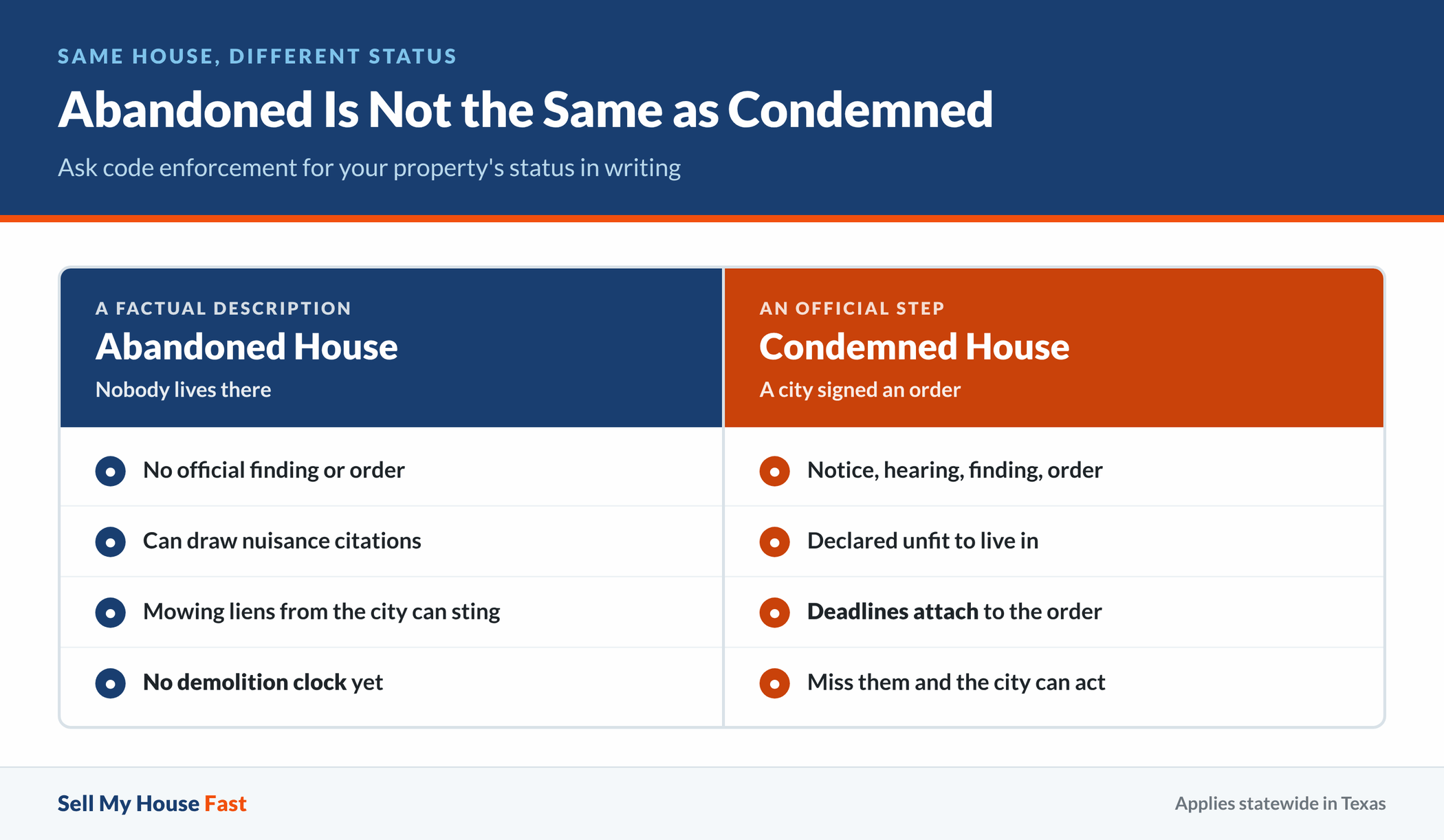
Abandonment is a factual description. Nobody’s living there, the grass is three feet high, and the mail piles up. A condemned house in Texas has gone through an official step: notice, a hearing, a finding, an order. Paperwork exists. Someone signed it.
An abandoned property might draw nuisance citations and mowing liens from the city, and those sting, but there’s no demolition clock. Once a structure gets declared substandard, deadlines attach. Miss them and the city can act.
Where the two overlap is in how they got there. Most condemned houses in Texas spent a stretch abandoned first, because vacancy invites copper thieves, squatters, and roof leaks nobody catches until the ceiling is on the floor. I’ve walked into vacant houses in San Antonio’s Dellview area where the only real damage started with one busted window.
Owners frequently tell me their place is condemned when it’s really a stack of unaddressed code violations. Those two situations call for completely different moves. Call the city’s code department and ask for the status in writing before you make any decision about selling.
What Are the Grounds for House Condemnation in Texas?
If a firefighter wouldn’t walk into it, your city probably won’t let anyone live in it either. That’s the rough test. Beyond that, the specific triggers for a condemned house in Texas come from local ordinances, and they cluster around a handful of failures.
The biggest danger among them is structural collapse. Foundation movement is brutal on North Texas clay soil, and I’ve seen slab houses in Garland where the exterior wall separated from the frame by an inch and a half. Fire damage runs a close second, especially when a roof structure burns and the rest of the house sits open to weather for months.
No working plumbing, no potable water, no safe electrical service, no heat: any one of those can land a house on the substandard list. Add raw sewage backing up under a pier-and-beam house in Houston’s Fifth Ward and you’ve got a condemnation case that writes itself.
Mold after flooding is its own Texas category. Gulf Coast storm water sits in walls, and a house that took three feet of water and never got gutted will fail an inspection badly. If your house is soaked but not posted yet, here’s how to sell a water-damaged house in Texas before it gets that far.
The usual advice is to fight the determination. I’d push back on that for most owners. Fighting makes sense when the finding is flat wrong or when you’ve got financing lined up and a contractor ready Monday. When neither is true, you’re spending legal money to delay an outcome you can’t fund, and the condemned house in Texas keeps accruing taxes and insurance problems the whole time.
Your city’s building standards commission can tell you exactly which section of its ordinance your property violated.
How Long Does It Take to Condemn a House in Texas?
Early last year, a longtime landlord in Mesquite called me with a foreclosure auction date already on the calendar. The city had just scheduled a substandard building hearing on the same duplex. His garage held four decades of plumbing tools from the business he’d retired from. He was working against two clocks on one property, with maybe five weeks of usable runway.
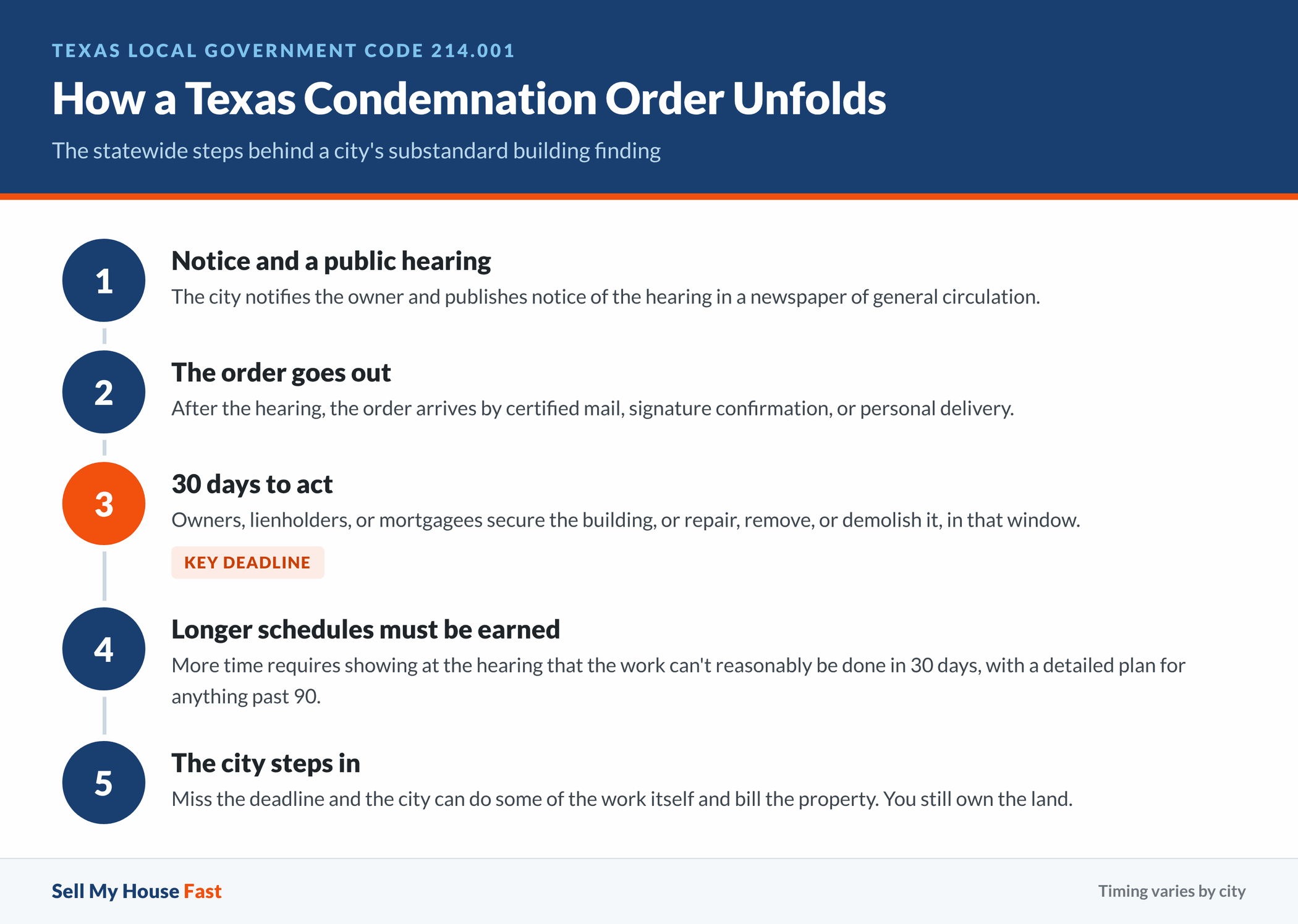
You can use the statutory architecture as landmarks for a condemned house, though timing varies by city. The municipality must give the owner notice and then hold a public hearing. Afterward, the city promptly mails the order by certified mail with return receipt requested, or delivers it using signature confirmation or personal delivery. Within 10 days of the order, it also publishes the hearing date and the result in a newspaper of general circulation.
The owner, lienholder, or mortgagee must secure the building from unauthorized entry within 30 days, or repair, remove, or demolish it in that same window. Owners get more time only if they show at the hearing that the work can’t reasonably be done that fast. Even then, the city can’t give you more than 90 days unless you earn it. You’d submit a detailed plan and time schedule at the hearing and establish that the scope and complexity of the work make 90 days impossible.
So the realistic answer: months from first citation to hearing, then a fairly tight repair window once the order lands, though in the biggest cities appeals move faster by design. Courts are told to hear these appeals with as little delay as possible, and when the city has 500,000 or more people, the appeal runs on the accelerated track. That takes in Houston, San Antonio, Dallas, Austin, Fort Worth, and El Paso. You can read the full statute at Texas Local Government Code Section 214.001.
Can You Still Live in a Condemned House in Texas?
A city has the option to order occupants out, but it doesn’t always exercise it on day one. Under the statute, after the public hearing the municipality may order the building vacated, and it may also order that occupants be relocated within a reasonable time. “May” is doing heavy lifting in that sentence.
In practice, though, staying is a bad bet. Utilities get disconnected, and homeowners insurance on a condemned house in Texas is nearly impossible to maintain, so without coverage, one kitchen fire wipes out whatever equity the land holds. Tenants complicate it further, because you can’t collect rent on a dwelling the city has declared unfit.
Do you have family still in the house? That single fact changes the whole sale strategy, and it needs to be the first thing you tell any buyer. Building a relocation timeline into the closing is normal and negotiable.
Owners who freeze up miss the hearing notice, miss the order, and lose the chance to argue for a longer repair schedule. A condemned house in Texas punishes avoidance more than almost any other property problem I handle.
If the city hasn’t ordered you out yet, use that window, because once it does your options narrow fast. Pull documents, retrieve belongings, and get the title picture clear. We buy occupied properties in this condition regularly across North Texas and can structure a move-out period into the contract.
Can You Sell a Condemned House in Texas?
Yes, and the sale is usually the smartest financial move on the table.
Nothing in Texas law blocks the transfer. You hold title, so you can convey it. What you can’t do is pretend the condition away. An as-is clause doesn’t eliminate your disclosure obligations under Texas Property Code § 5.008, and a seller who actively conceals a material defect stays liable even with as-is language in the contract.
So disclose the order. Hand over the hearing paperwork. Section 5.008 requires most sellers of a single-family house to deliver a written notice describing the property’s condition and known defects, and the city’s finding is about as material as a defect gets. Certain transfers sit outside that requirement: court-ordered transfers, foreclosure or trustee sales, transfers between co-owners or to a spouse, and divorce-decree transfers are among the listed exemptions. You can read the full disclosure statute at Texas Property Code Section 5.008.
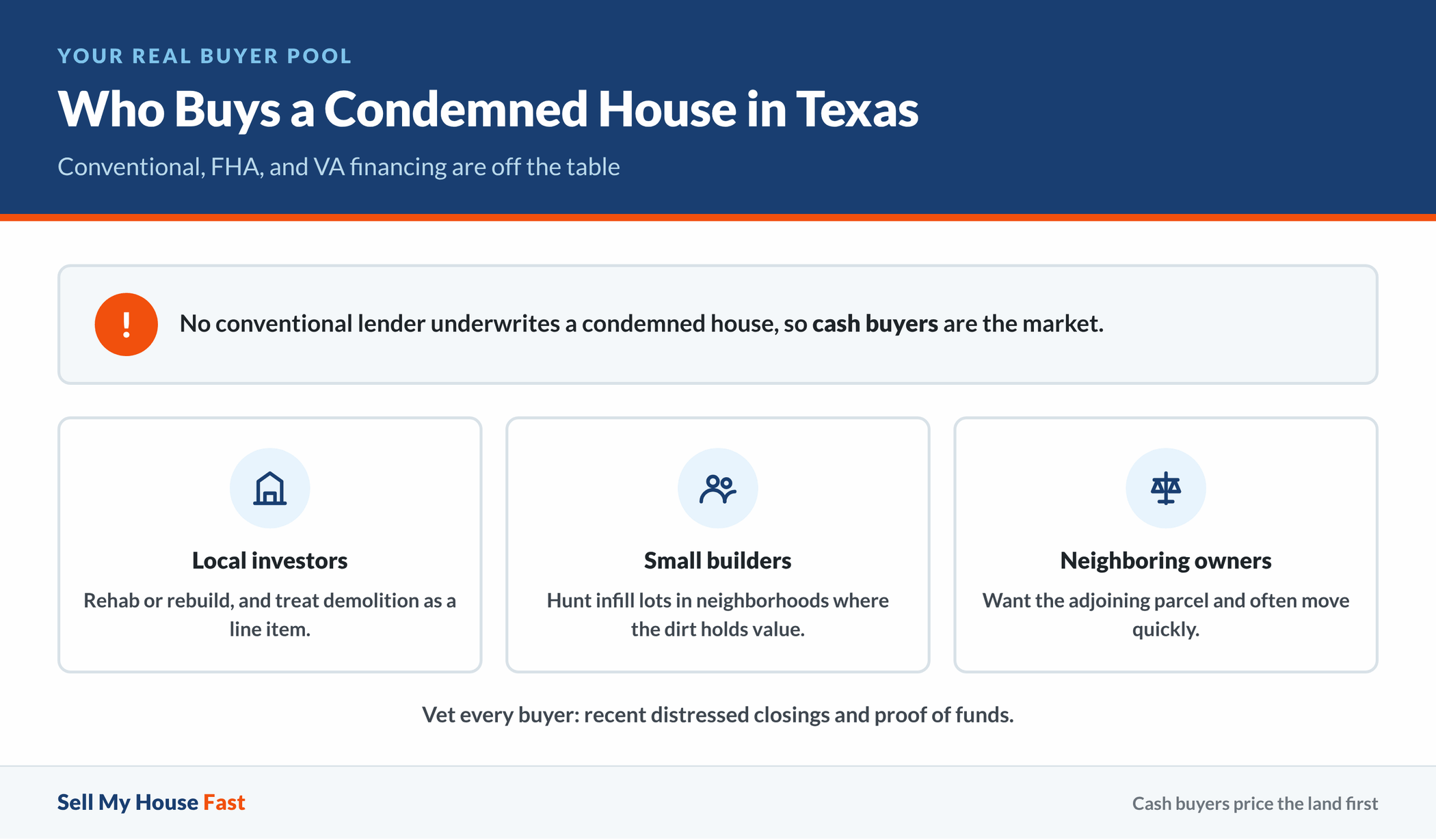
No conventional lender underwrites a condemned house in Texas, and FHA and VA are out entirely. That removes roughly the entire retail buyer pool in one stroke.
So you’re left with cash buyers. Investors, builders, and land buyers who price the lot and treat the structure as a demolition line item. A condemned house in Texas in a strong infill neighborhood can still trade well, because the dirt in places like Oak Cliff or Houston’s Heights carries real value on its own.
The statewide pace is slow right now, and your demolition clock isn’t.
How to Sell a Condemned House in Texas
In October 2026 the typical Texas listing spent 68 days on the market, five more than the national median of 63, per Realtor.com data that the St. Louis Fed tracks. A placarded house would sit far longer than a typical listing, and a 30-day repair order won’t wait for it.
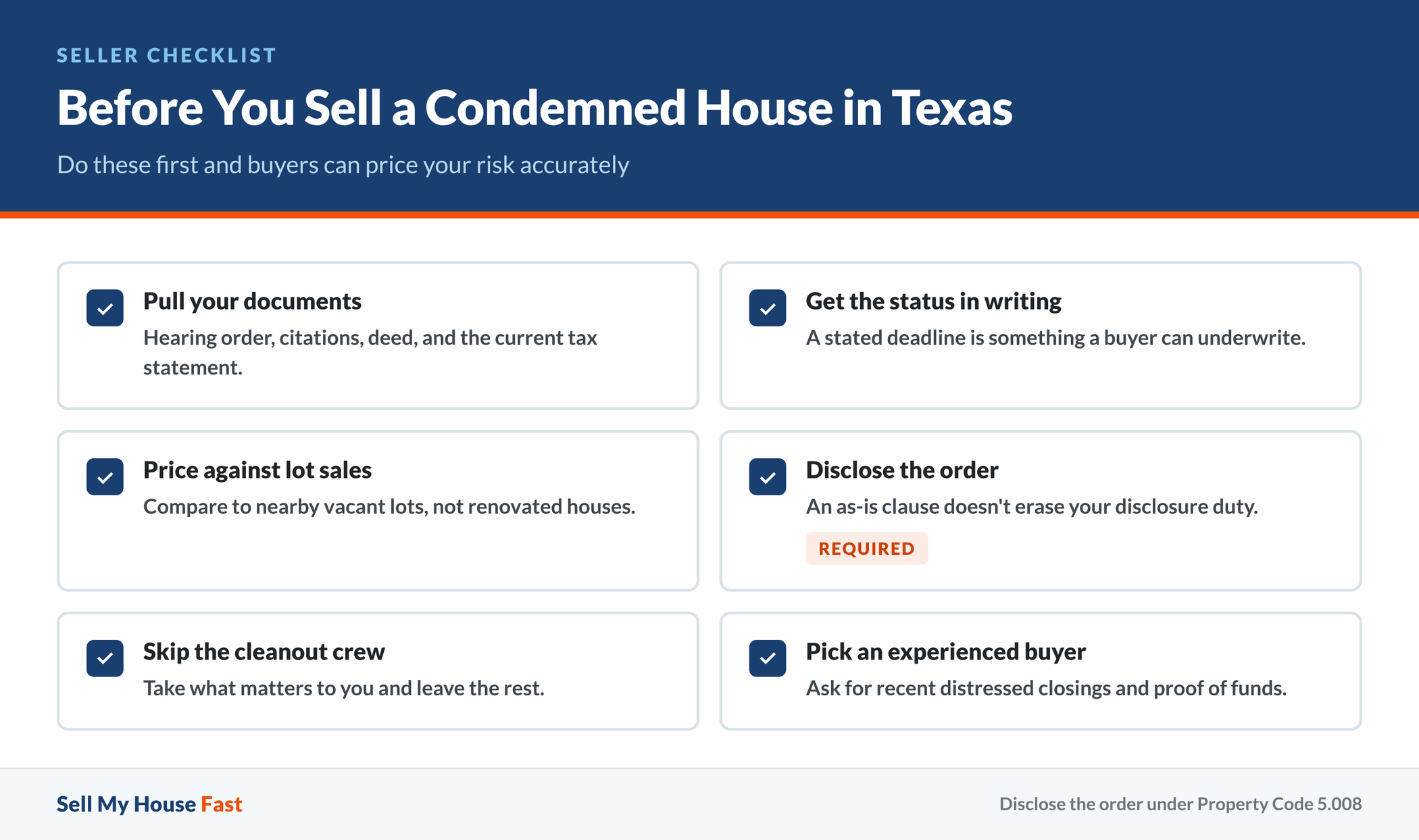
Start with documents. Pull the hearing order, any citations, your deed, and the current tax statement. Title problems surface constantly on distressed properties, and unreleased liens from a long-gone contractor can stall a closing for weeks.
Second, get the city’s status on the condemned house confirmed in writing. Buyers price risk, and an unknown risk prices higher than a known one. A demolition order with a stated deadline is something an experienced buyer can underwrite; a vague “I think they condemned it” costs you money.
Third, price the land honestly. Comparable sales for a condemned house in Texas mean nearby lot sales, not renovated houses down the block. Demolition on a modest single-story runs real money, and buyers subtract it before they offer.
Should you clean it out first? Generally no. Haul off anything with sentimental or genuine resale value, then leave the rest. Cash buyers budget for debris, and paying a cleanout crew to prep a house headed for a dumpster is money you won’t recover.
Last, choose a buyer who’s closed on condemned properties before. First-timers back out when they read the order, and a dead contract on a condemned house in Texas costs you three weeks you didn’t have.
How Do I Find Buyers for My Condemned House?
One heir inherited her uncle’s boarded-up house in Dallas and found most agents wouldn’t even return her calls. Agents in Texas earn commissions on marketable properties, and a condemned house in Texas can’t be shown safely, photographed appealingly, or financed conventionally. Many will decline the listing outright. The ones who accept it often list it as a teardown anyway, and you’ve added a commission to a cash transaction you could have reached directly.
Your real buyer pool has three parts. Local investors who rehab or rebuild, small builders hunting infill lots, and neighboring owners who want the adjoining parcel. Houston’s median sale price averaged about $333,400 from January through June 2026, down 0.5% from a year earlier, per Redfin’s Houston numbers. Flat retail prices make buyers more selective about condition, not less.
Reach them directly. Contact investors whose names appear on recent cash deed filings in your county, call builders active in your zip code, and talk to the neighbors. Vet whoever responds: ask for recent closings on distressed property and proof of funds, since anyone can promise a quick close.
An heir in Round Rock reached me on a Thursday, wanting nothing to do with the inherited bungalow her brother had let fall apart. Mold had taken the back bedroom and the city had already posted it. She asked me to handle the paperwork, the cleanout, and the city correspondence. We closed without her setting foot inside again. Inherited houses with a city placard make up a steady share of the calls I get. Sell My House Fast handles that kind of transaction regularly, and a buyer who already knows the condemnation process saves you weeks of explaining.
Frequently Asked Questions About Selling a Condemned House in Texas
What Conditions Qualify a House for Condemnation?
Cities look for a structure that endangers people, such as one at risk of collapse or with fire-damaged framing. Unsafe wiring and missing water or sewer service count too, as do mold after flooding and a building left open to trespassers. Each municipality writes its own minimum standards ordinance, so the exact checklist differs between Lubbock and Corpus Christi. One failure usually isn’t enough; it’s typically several stacked together. Your local building standards commission can tell you which provisions your property violated and what would cure them.
Does a Condemnation Order Mean I Lose Ownership of the Property?
No. You keep title, and you keep the right to sell, repair, or transfer the property. What the order does is restrict occupancy and impose a deadline for action. If the city ends up demolishing the structure, it can assess its costs against you and place a lien on the property, with homestead protections under the Texas Constitution limiting that in some cases. You’d still own the land afterward.
Will a Buyer Need an Appraisal or Inspection?
A cash buyer typically skips the formal appraisal on a condemned house because no lender is requiring one. Most will still walk the property, and some bring a contractor to estimate demolition or rebuild costs. The walkthrough sets their number. If a buyer refuses to inspect at all and offers sight-unseen, treat the offer as soft until you see earnest money in a title company’s hands.
Can I Sell If the City Already Scheduled Demolition?
Often yes, but speed matters and so does communication with the city. Some municipalities will pause an abatement when a new owner presents a credible repair plan and timeline. Your buyer needs to know the scheduled date before signing, because that date drives everything about the closing. Get the status in writing from code enforcement and hand it to every buyer you talk to.
How Much Less Will I Get Compared to Market Value?
Expect the offer on a condemned house to reflect land value minus demolition or rebuild cost, minus the buyer’s risk and margin. In neighborhoods where lots are scarce, that can still be a healthy number; in rural counties with cheap land, the structure’s removal cost can swallow most of it. Comparing your figure to renovated houses nearby will only frustrate you. Compare it to vacant lot sales within a few blocks instead.
Do I Have to Pay Property Taxes on a Condemned House?
Yes, the tax obligation continues regardless of occupancy status. You can ask your county appraisal district to reassess based on current condition, and documented damage often lowers the assessed value meaningfully. That reduction doesn’t erase what’s already owed. Delinquent taxes get settled at closing out of sale proceeds, so they don’t have to stop a sale.
Selling a Condemned House in Dallas and North Texas
Only about one in five Dallas homes sold within two weeks in the first half of 2026, by Redfin’s count, which is a slow market to list in when a demolition deadline is running. We buy condemned and damaged houses in Dallas, in Fort Worth, and across the smaller North Texas cities around them, and we buy houses in Garland too.
Talk With Sell My House Fast About Your Condemned House
Maybe you’re holding a placard, a hearing notice, or just a bad feeling about where your property is headed. I’m glad to look at your condemned house with you and tell you plainly what I think it’s worth. No obligation, no pressure, and no hard sell if selling isn’t the right answer for your situation. You can reach out to Sell My House Fast or fill out the form below.