

A hairline crack above a door frame in August can turn into a quarter-inch gap by Thanksgiving. That’s not bad luck. Clay doing what clay does under almost every slab in this state is why so many owners end up selling a house with foundation problems in Texas. I’ve spent years buying houses from homeowners who got a repair bid and froze. If that’s you right now, you’ve got more paths forward than a single estimate suggests.
What Causes Foundation Problems in Texas Homes?
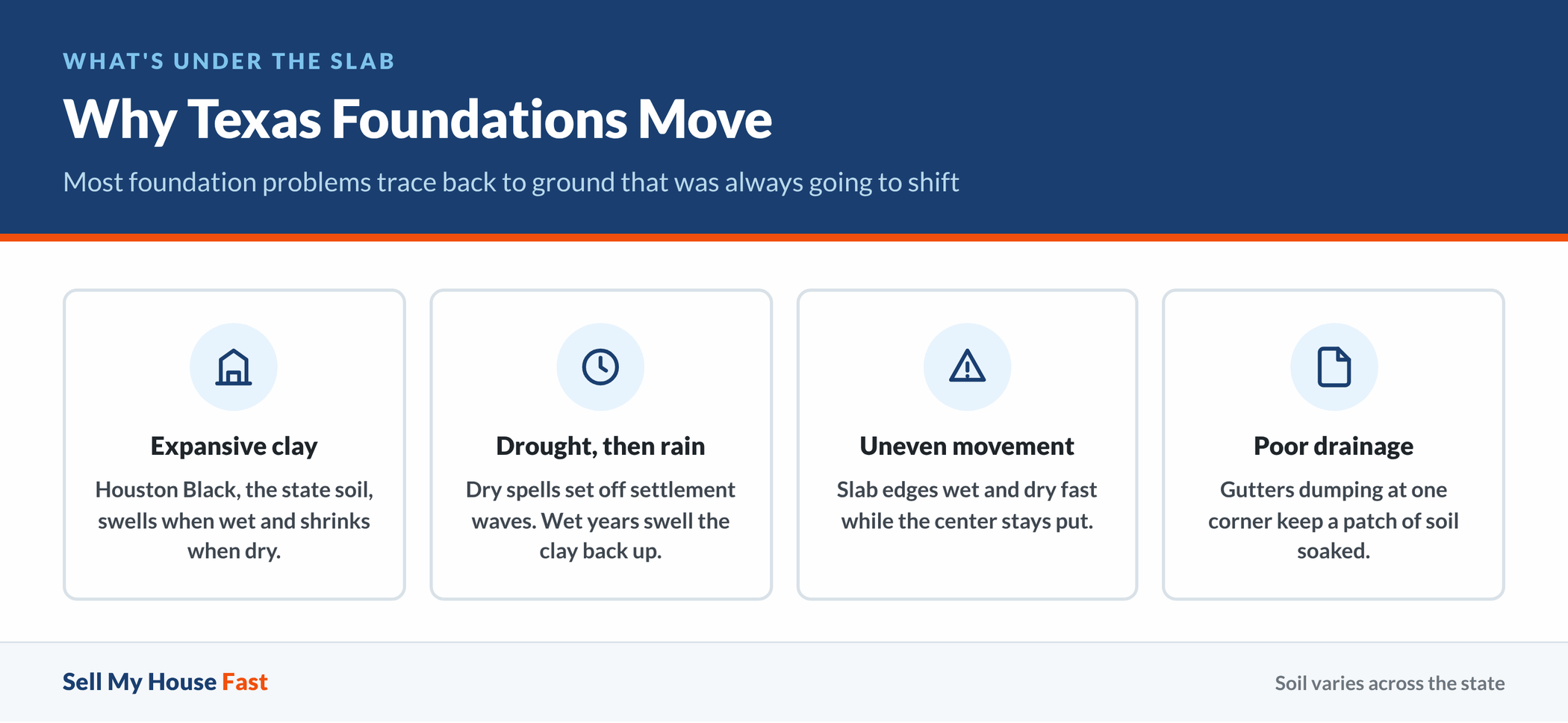
Texas holds some of the most extensive expansive soils in the country. The signature soil of that belt is the Houston Black series, the designated state soil, a deep churning Vertisol that’s the textbook example of shrink-swell clay.
Dry spells push the problem into overdrive. Expansive soil with constant moisture barely moves, but Texas movement follows the weather. The multi-year droughts of 2011 and 2022 to 2023 each set off statewide waves of settlement repairs. Wet years afterward swell those same clays back up. That cycle repeats, and each pass leaves a little more damage behind.
Foundation problems get punishing here because the movement isn’t even. Slab edges wet and dry quickly while the center stays put, so foundations tilt and flex instead of floating evenly, and that differential movement is what cracks brick and racks door frames.
Drainage decides a lot. Gutters that dump at the corner of the house keep one patch of soil soaked all winter.
The ground itself changes as you drive across the state. Hill Country homes sit on thin clay over shallow limestone, where differential support and slope drainage drive movement. El Paso has minimal clay but collapsible desert soils that drop abruptly the first time they get wet. Those regional differences change which repair method a contractor should recommend.
Most Texas foundation problems trace back to ground that was always going to move.
How Do Foundation Problems Affect Your Home’s Value in Texas?
Appraisers rarely deduct the repair cost. They deduct the repair cost plus a stigma discount, and that second number is where sellers lose real money on Texas homes with foundation problems.
You should price more carefully now, since buyers have room to be picky. The statewide median sale price slipped 0.4 percent to $333,628 in the third quarter of 2026, and inventory rose to 5.5 months, per the Texas Realtors quarterly report.
Underwriters tighten the screws further. Conventional and FHA underwriting both get squirmy when an inspection report names structural movement, and that knocks out a chunk of your buyer pool before anyone negotiates. Cash and renovation loans fill the gap, but those buyers price for risk.
One listing I followed had slab movement noted on page four of the inspection report, and every showing ended the same way.
I keep running into one pattern: sellers assume the discount scales with the severity of the foundation problems. It doesn’t. A home with two inches of deflection and a home with a quarter inch of deflection often draw similar buyer hesitation, since most buyers can’t tell the difference and simply hear the word “foundation.”
Documentation closes some of that gap. An engineer’s letter stating the movement is within tolerance will save you more negotiating room than any amount of cosmetic patching.
What Does a Foundation Repair Company in Texas Do?
Mostly it lifts and supports. A foundation repair company in Texas typically drives piers down through the shifting clay to stable soil or bedrock, then lifts and supports the affected sections. Most Texas homes built after roughly 1960 sit on slab-on-grade, a single concrete pad poured on the soil. Older homes, especially pre-1960 and in East Texas, often use pier and beam with a crawl space instead. So repair usually involves shimming or replacing interior supports and sometimes sistering damaged beams.
The sequence usually starts with an elevation survey, where a technician shoots floor levels room by room and maps where the slab has dropped or heaved. Typical Texas jobs run 8 to 15 piers along one or two sides of the house.
Movement under a slab breaks sewer lines, and lifting a slab with a cracked line underneath creates a second problem on top of your first. A hydrostatic test before and after the lift should be standard, not an upsell.
Drainage work often rides along with the pier contract. Grading, French drains, root barriers near large trees: these address the moisture swings that caused the structural movement to begin with.
I’d read warranties carefully, since they vary wildly, and I’ve seen buyers walk away from a sale over this exact detail. Some transfer to the next owner at no cost; others charge a transfer fee or die the moment you sell. A transferable warranty is worth real dollars at the closing table in Texas, so ask about it before you sign anything.
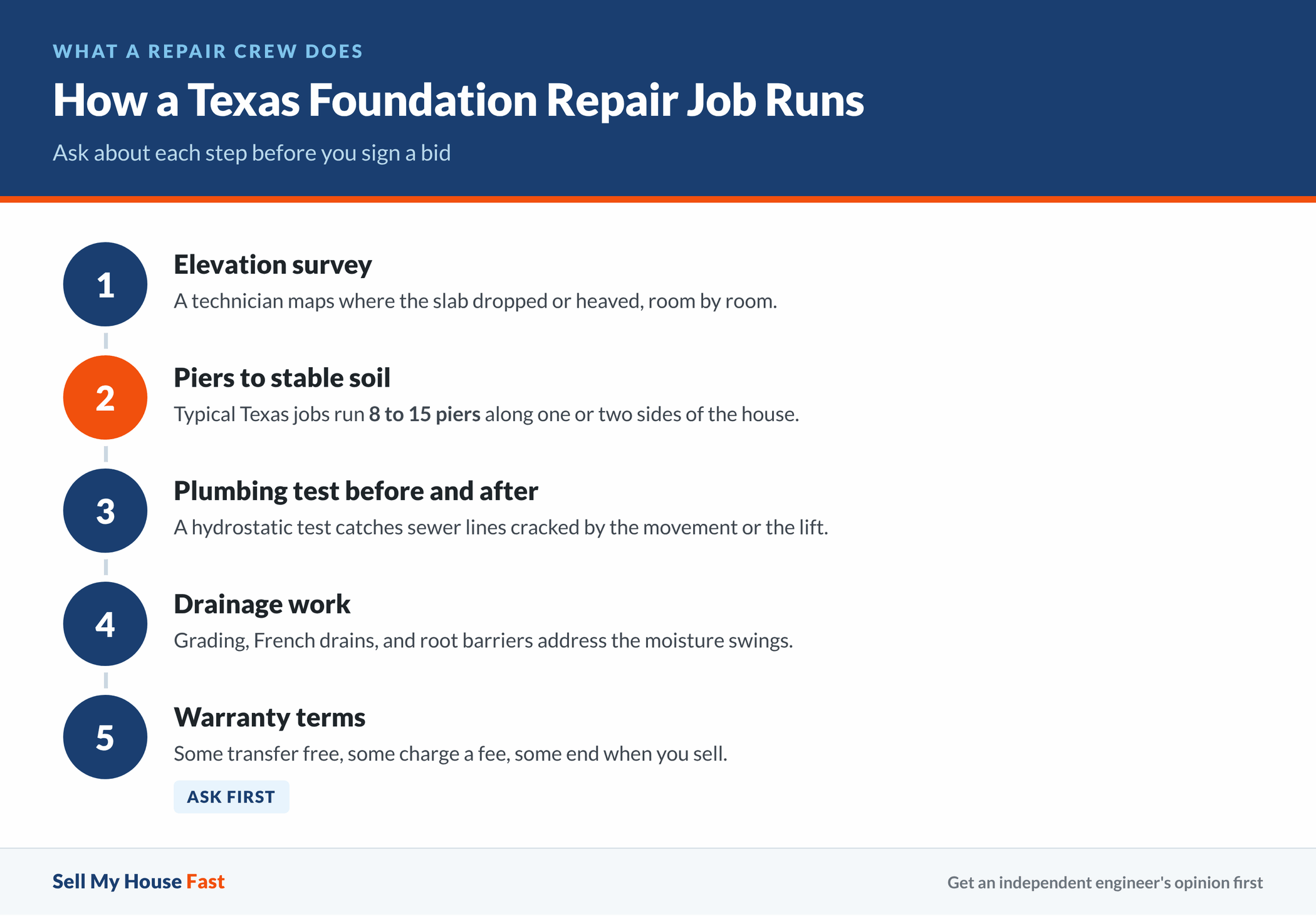
One more thing worth knowing: engineering reports and contractor estimates serve different masters. A structural engineer works for you and has no pier quota to hit, so their read on the problem isn’t tangled up with a sales target. Paying a few hundred dollars for an independent opinion before you accept a five-figure bid is the single best money I’ve seen Texas sellers spend on foundation problems.
How Much Does Foundation Repair Cost in Texas?
Foundation repair pricing in Texas swings pretty widely. Contractor-published 2026 figures put most Texas single-family foundation jobs between $3,500 and $25,000, with a typical Dallas-Fort Worth pier job at $6,500 to $14,000. Treat those as rough guides, because your own written bids are what count.
Pier type drives most of that variation. Pressed concrete piers are the Texas default and the cheapest per unit. Steel piers cost more and go deeper, which matters on volatile ground. Replacing a single pier on a pier-and-beam home in 2026 runs between $2,000 and $6,000 depending on depth and material.
I’ve watched identical scopes come back $7,000 apart from two licensed Texas companies in the same ZIP code, and the cheaper one wasn’t the worse one.
Budget beyond the piers, too. Plumbing repairs, interior sheetrock patching, re-stretching carpet, repainting, replacing cracked tile: the finish work after a lift routinely adds thousands that no pier quote includes.
So what do you do when the repair bid lands near a quarter of your home’s equity? Some Texas sellers borrow against the house. Others sell as-is and let the next owner handle the foundation problems with their own contractor. This really just comes down to how much of your life you want to spend managing a construction project, plus your timeline and cash position.
Do You Have to Disclose Foundation Problems When Selling in Texas?
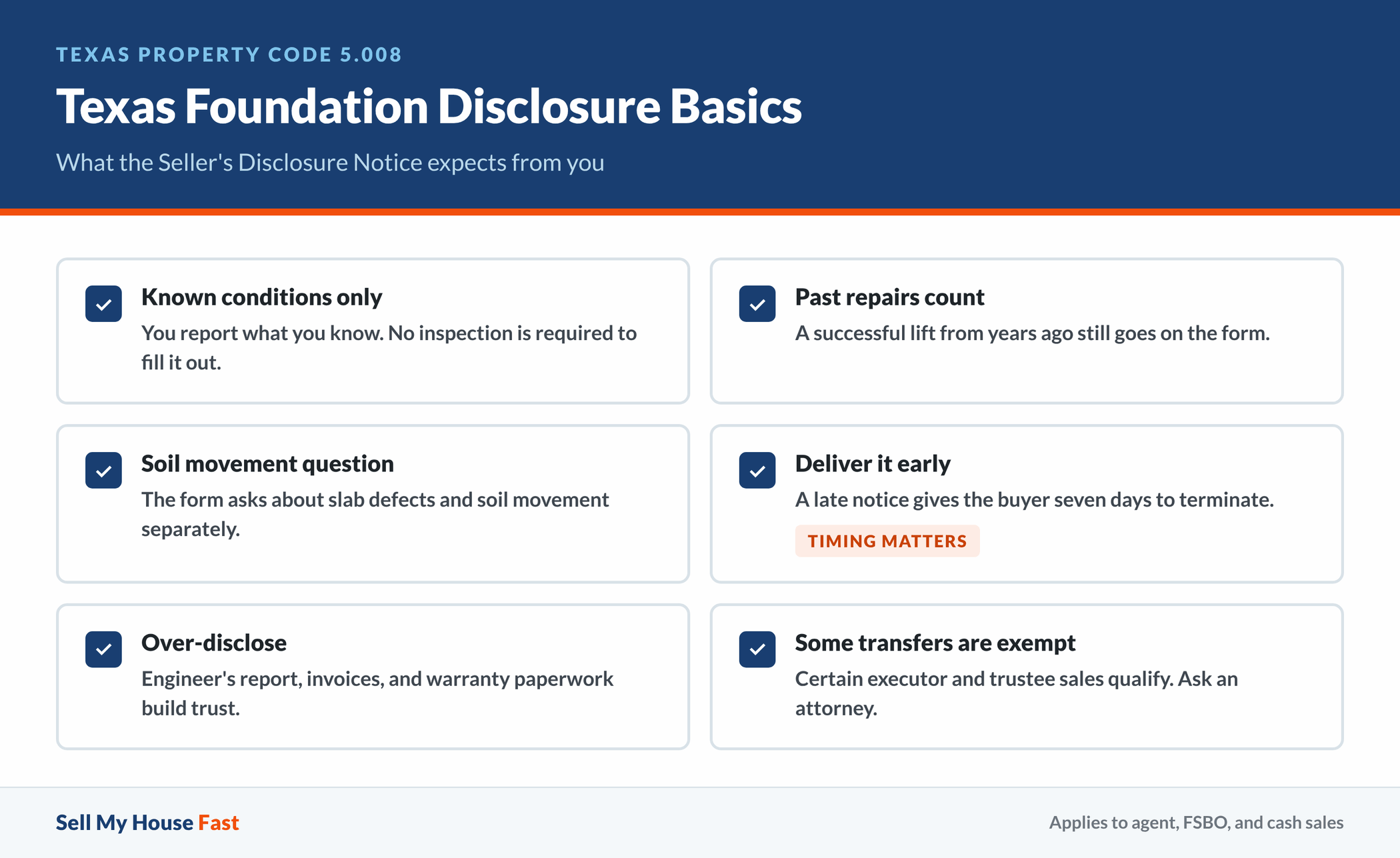
Section 5.008 of the Texas Property Code is the number to remember. It requires almost every residential seller to complete a Seller’s Disclosure Notice, and that form asks directly about known foundation and slab defects, plus a separate question about soil movement. The full statute text sits on the Texas Legislature’s site.
A common misconception is that Texas law makes sellers perform a detailed inspection before completing the disclosure; the statute generally requires disclosure of known conditions instead. You’re not obligated to go hunting for foundation problems. You are obligated to report what you already know.
Past repairs count. Disclosure of structural repairs covers any work performed on the load-bearing portion of a residence, including the foundation, walls, and roof. Even a successful lift from 2014 still belongs on the form.
You should understand the consequence of timing. If the disclosure notice reaches the buyer late, after the contract is already signed, the buyer generally has the right to terminate within seven days of finally receiving it, for any reason. Handing the notice over before the contract gets signed protects your sale.
Selling as-is doesn’t change any of that, even when you’re selling a condemned house in Texas. The disclosure requirement applies whether you sell through an agent, list FSBO, or sell to a cash buyer.
My advice runs against what nervous sellers want to hear: over-disclose. Hand over the engineer’s report, the old invoices, the warranty paperwork, all of it. Buyers who see a thick folder about your foundation problems tend to trust the rest of the house, and a documented Texas seller sleeps better after closing than a vague one.
Exemptions exist for certain transfers, including some sales by executors and trustees. Any Texas real estate attorney can tell you in one phone call whether yours qualifies.
Should You Repair Foundation Problems Before Selling in Texas?
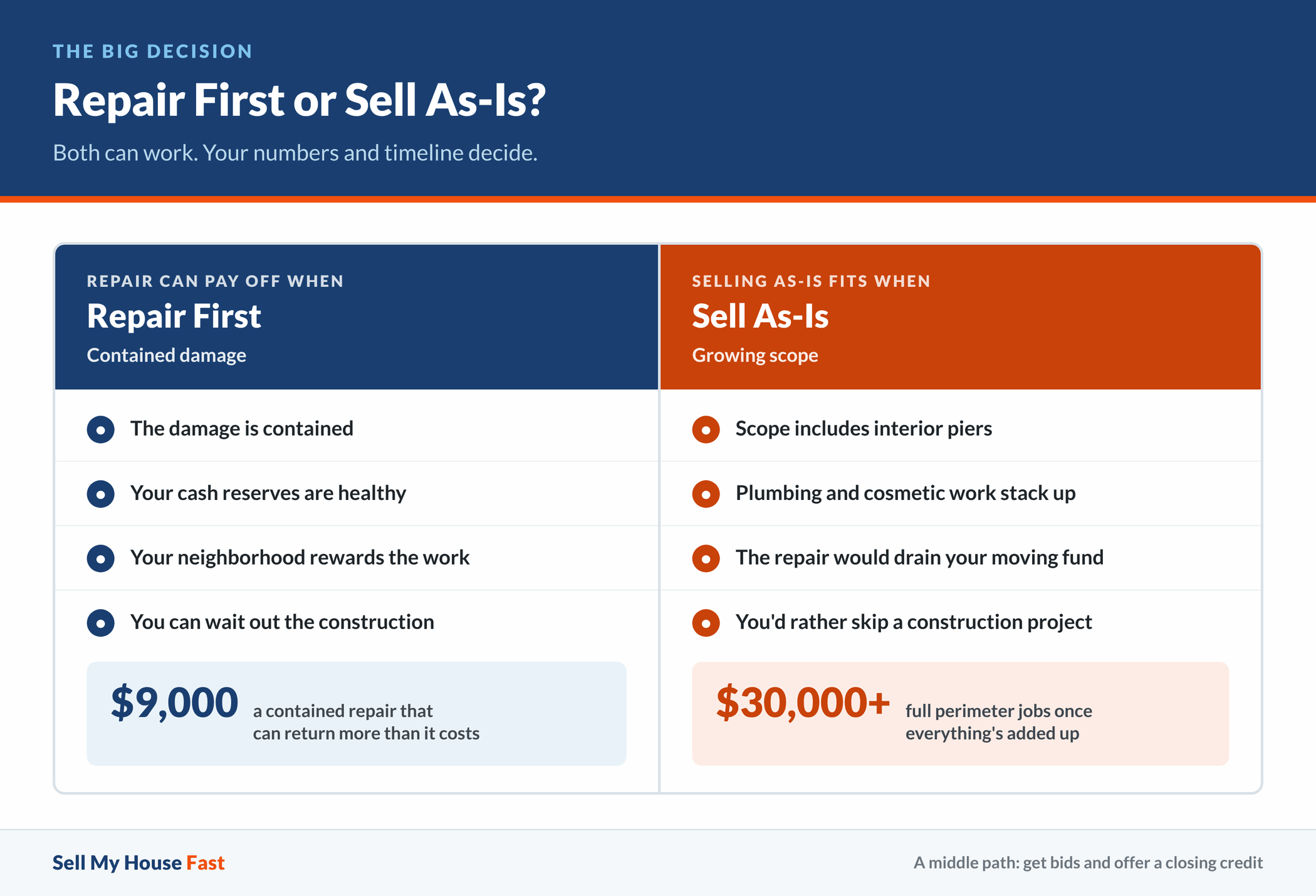
Repairing makes sense when the damage is contained, your cash reserves are healthy, and your neighborhood supports a price that rewards the work. A $9,000 repair on a home in Plano or Sugar Land can absolutely return more than it costs.
Repairs stop making sense when the scope grows. Full perimeter jobs with interior piers, plumbing replacement, and cosmetic restoration can run past $30,000 once everything’s added up, and recovering that in a slower Texas market is a gamble. Texas listings sat a median of 68 days in October 2026, against 63 days nationwide, per Realtor.com data published by the St. Louis Fed. Add six to ten weeks of construction before you even list, and you’re looking at most of a year.
Lifting one corner and leaving the rest produces a disclosure that reads worse than doing nothing, since now you’ve documented active movement and an incomplete response.
Think about the money honestly. If the repair drains your moving fund, you’ll arrive at your next home with no cushion, and foundation problems have a way of generating surprise invoices mid-project in Texas clay.
People forget the middle path exists. Get the engineer’s report, get two bids, then offer the buyer a credit at closing instead of doing the work yourself. The buyer picks their own contractor, you skip the construction headache, and the transaction prices the foundation problems openly.
Can You Sell a House with Foundation Problems in Texas?
Yes, you can sell. Texas homes with foundation problems change hands every single day, and a sale is always possible. What matters is which buyer pool you’re aiming at. Three realistic routes exist.
Going the real estate agent route works when the movement is mild and documented. Price it below comparable homes, disclose early, and expect fewer showings than a clean comp down the street. Your agent should screen for cash and renovation financing up front rather than discovering the problem during the option period.
Selling to an investor or direct buyer trades price for certainty. We look at the repair scope as a line item, not a dealbreaker, and we close without an appraisal or a lender’s underwriter weighing in on your slab. Sell My House Fast buys Texas houses in exactly this condition, and we’ll tell you plainly when listing would serve you better.
Carrying a note on a house with foundation problems widens your buyer pool past what banks allow, though it means staying involved for years. That suits some Texas sellers and horrifies others.
Price honestly from day one. Sellers who start at full retail hoping someone won’t notice end up accepting less after 90 days than they’d have gotten in week one. The price-drop history on the MLS tells every buyer exactly how desperate you’ve become.
In a slow market, sellers care more about cash than list price. A firm offer that closes in three weeks tends to beat a higher offer that collapses at the inspection, and I’ve watched that play out enough times to stop being surprised by it.
What Other Factors Affect Home Value After Foundation Repair in Texas?
“We fixed it, so we should get full market value.” I hear that a lot, and I understand the logic. Repaired foundation problems still register with Texas buyers as a history, though, rather than a non-event.
Location carries most of the weight. Dallas’s median sale price averaged about $406,500 in the first half of 2026, down 2.2 percent from a year earlier, per Redfin’s mid-year review. Strong demand absorbs structural history. Flat submarkets give buyers time to walk.
A 1968 pier-and-beam bungalow in a Houston Heights-adjacent pocket that’s been leveled and reinforced reads very differently than a 2006 slab home with its second round of piers.
Buyers also weigh what the repair didn’t address. Original cast iron sewer lines, dated electrical, a roof near the end of its run: those stack onto the structural history and compound the discount. Fix the foundation problems and leave a 22-year-old HVAC system in place, and the buyer prices both.
Warranty transferability moves the needle at the closing table. Any lifetime transferable warranty from an established company reassures a buyer in a way that a stack of paid invoices never will.
Spring listings in Texas draw more traffic than November listings, and a house with disclosed foundation problems benefits from every extra set of eyes it can get.
A couple in Killeen had been quietly covering two mortgages for close to a year after a job transfer pulled them north. Their old house sat empty with a cracked back patio and an engineer’s report in a kitchen drawer. By the time they called on a Tuesday afternoon, the double payments had cost them far more than the repair bid ever would’ve.
Frequently Asked Questions About Foundation Problems in Texas
Why Does Texas Have So Many Foundation Issues Compared to Other States?
The ground is the reason. Huge stretches of populated Texas sit on expansive clay that physically grows when it takes on water and shrinks back during dry spells, and our swing between drought and downpour is extreme. Add decades of slab-on-grade construction built directly on that clay, and you get a state where foundation problems are routine rather than rare.
Will a Lender Approve a Mortgage on a Texas House with Foundation Problems?
Sometimes, but it depends on severity and loan type. Conventional and government-backed lenders often require a structural engineer’s evaluation, and if the report calls the movement active or unsafe, they’ll usually demand repairs before funding. Renovation loans and cash buyers don’t face that hurdle, which is why those two groups make up most of the buyer pool for Texas homes with heavy structural movement.
Do I Have to Disclose Foundation Repairs That Were Completed Years Ago?
Yes. The Texas seller’s disclosure notice asks about structural repair history, not just current defects, so a lift completed a decade ago still goes on the form. Include the date, the contractor’s name, the engineer’s report if you have one, and note whether the warranty transfers to the new owner.
How Long Does Foundation Repair Take in Texas?
Most pier jobs run three to seven working days for the structural portion, assuming decent weather and no plumbing surprises underneath. Interior piers, tunneling, and the cosmetic restoration afterward stretch that out considerably. Plan on several weeks between the first crew arriving and the house being presentable for showings.
Is It Cheaper to Repair Foundation Problems or Sell the House As-is in Texas?
That depends entirely on your numbers. Compare the total repair cost, including plumbing and cosmetic work, against the discount a Texas as-is buyer would apply, then add the carrying costs of several extra months of mortgage, taxes, and insurance. Plenty of sellers find the as-is route nets them nearly the same amount with a fraction of the stress.
Can I Sell a House with Foundation Problems Without Getting an Inspection First?
You can, though an engineer’s report usually helps you more than it hurts. Without documentation, buyers imagine the worst and price accordingly; with a report in hand, you’re negotiating against a specific number instead of a fear. Either way, your disclosure obligation covers what you know, so a report you’ve already received has to be shared.
Does Homeowners Insurance Cover Foundation Problems in Texas?
Standard policies rarely cover damage from soil movement, settling, or expansion, since insurers treat that as a maintenance issue rather than a sudden loss. Coverage sometimes applies when a plumbing leak under the slab caused the movement, and that distinction is worth pursuing with your carrier. Read your policy’s earth movement exclusion before assuming anything.
Selling a House With Foundation Problems in Dallas
Dallas homes sat a median of about 66 days on the market in the first half of 2026, by Redfin’s count, and a disclosed slab issue usually stretches that further. We buy houses with foundation problems across Dallas and the rest of North Texas, so you can skip the repair bids if that suits you better.
Talk With Sell My House Fast About Your Foundation Problems
If you’re sitting with a repair estimate and no clear next step, I’d rather talk it through with you than see you guess. We’ll look at your numbers honestly, tell you if listing beats selling direct, and make you a straightforward offer if that’s the better road. No pressure, no obligation, and no hard feelings if you decide to keep the house and water the slab. You can reach out to Sell My House Fast or fill out the form below.