
A 1962 ranch house in Garland sat under contract for eleven days before the buyer’s inspector pulled back a corner of kitchen linoleum and found black mastic underneath. By Friday, the deal died. The following Monday, that seller called me, convinced her house was worthless, and she wasn’t even close to right.
Houses built before the early 1980s across Texas are full of materials nobody thinks about until an inspector says a word out loud. Thousands of them trade hands here every year.
What Is Asbestos and Why Does It Matter in Texas Homes?
Three siblings called me not long ago about their parents’ place in Pasadena, a brick ranch stuffed with thirty years of accumulated belongings. Ceiling tiles their dad had stacked up from a 1970s remodel he never finished still filled the garage.
Asbestos is a naturally occurring mineral fiber that builders loved for decades because it resists heat, fire, and corrosion. Millions of homes across Texas got built during the peak years of its use.
Why does any of this matter to someone selling a house? Because the health risk only shows up when the material gets disturbed. Intact asbestos sitting quietly under a layer of vinyl flooring isn’t releasing anything into your air. But sand it, drill it, scrape it, or smash it during a demo day and it releases fibers that nobody should breathe.
The diseases tied to long-term exposure to asbestos are real and serious: asbestosis, lung cancer, and mesothelioma. Those outcomes come from repeated, heavy inhalation of asbestos fibres over years, typically in industrial or trade settings, so the risk was never evenly spread across every job site. Texas has plenty of that history, from the Gulf Coast refineries down near Baytown to the shipyards along the coast.
A homeowner faces a different risk category entirely. A family living above an asbestos floor tile for twenty years faces a far smaller hazard than a pipefitter who worked around the material daily. A lot of coverage loses that distinction, leading Texas sellers to panic when they shouldn’t.
What should concern you is the condition of the material. Crumbling pipe insulation in a crawlspace under a Beaumont bungalow is a different conversation than sealed cement siding on a house in Lubbock, and I’ve seen buyers confuse the two during inspections. Friable material, the kind that crushes to powder under hand pressure, carries the actual danger.
Where Does Asbestos Hide in Texas Properties?
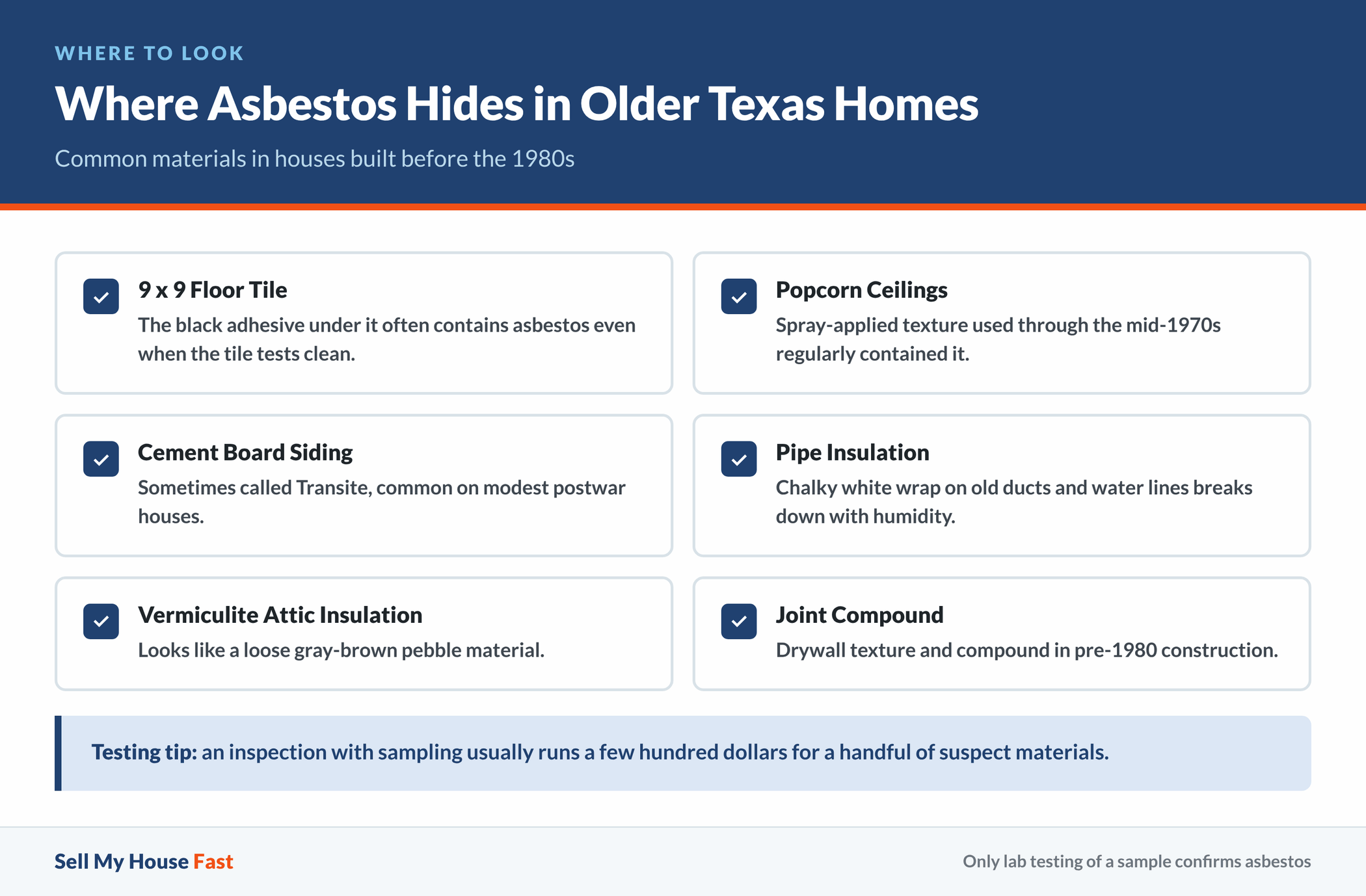
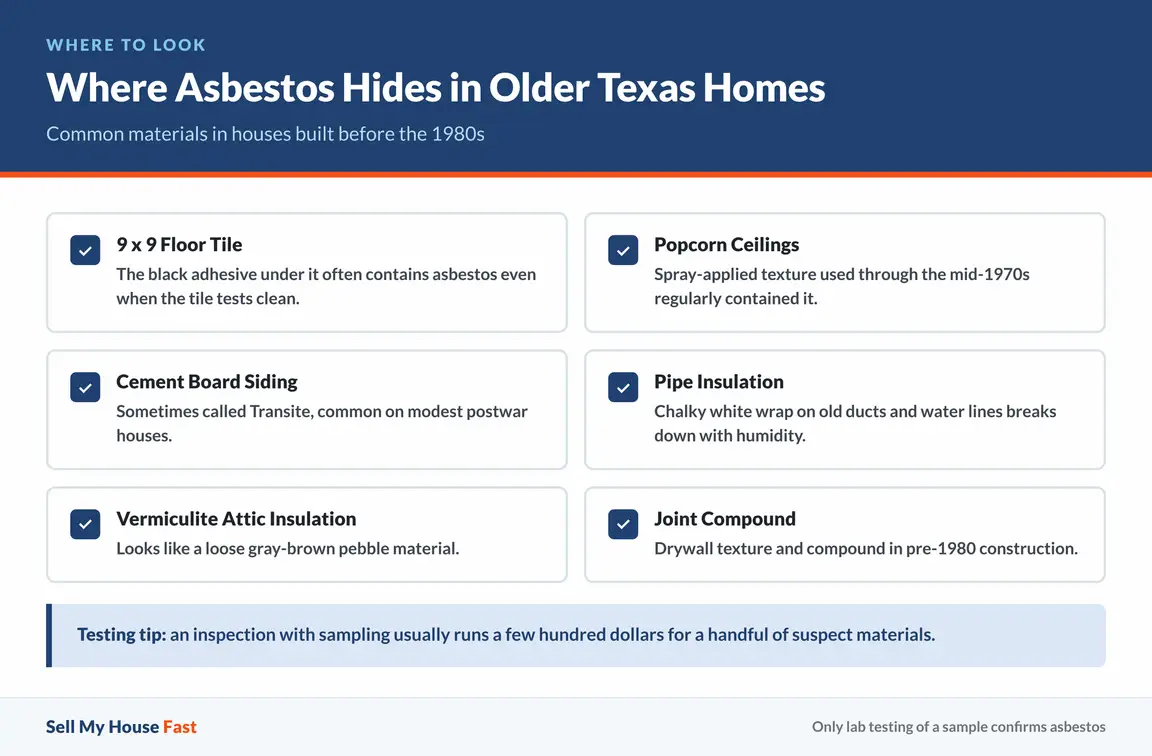
Vinyl floor tile measuring exactly nine inches by nine inches is a reliable tell, and the black adhesive under it often contains asbestos even when the tile itself tests clean.
Popcorn ceilings are the material Texas sellers ask me about most. Spray-applied texture used through the mid-1970s regularly contained asbestos, and plenty of homes in older Fort Worth neighborhoods like Ryan Place still wear it.
Siding and roofing come with their own history. Cement board siding, sometimes called Transite, shows up on modest postwar properties all over San Antonio and Waco. Asbestos roof shingles were marketed hard in the Panhandle because they held up against hail and heat.
Pipe insulation is the one I’d check first in any house near the coast. That chalky white wrap around old ductwork and water lines degrades with humidity, and Houston humidity is relentless.
Other common hiding spots in Texas properties include:
– Joint compound and drywall texture in pre-1980 construction – Old HVAC duct wrap and furnace gaskets – Vermiculite attic insulation, which looks like a loose gray-brown pebble material – Window glazing and caulk around original frames – Backing on old sheet linoleum in kitchens and utility rooms
A house built in 1995 in a Frisco subdivision is almost certainly free of asbestos in any meaningful quantity. A 1958 house in Oak Cliff probably has it somewhere, and that’s just how construction worked then.
Can you tell by looking? Not reliably. Laboratory analysis of a physical sample is the only way to confirm, so an inspection with sampling usually runs a few hundred dollars for a handful of suspect materials. I’d rather a Texas seller spend that money and know than guess on a disclosure form.
What Does Texas Law Say About Asbestos Disclosure?
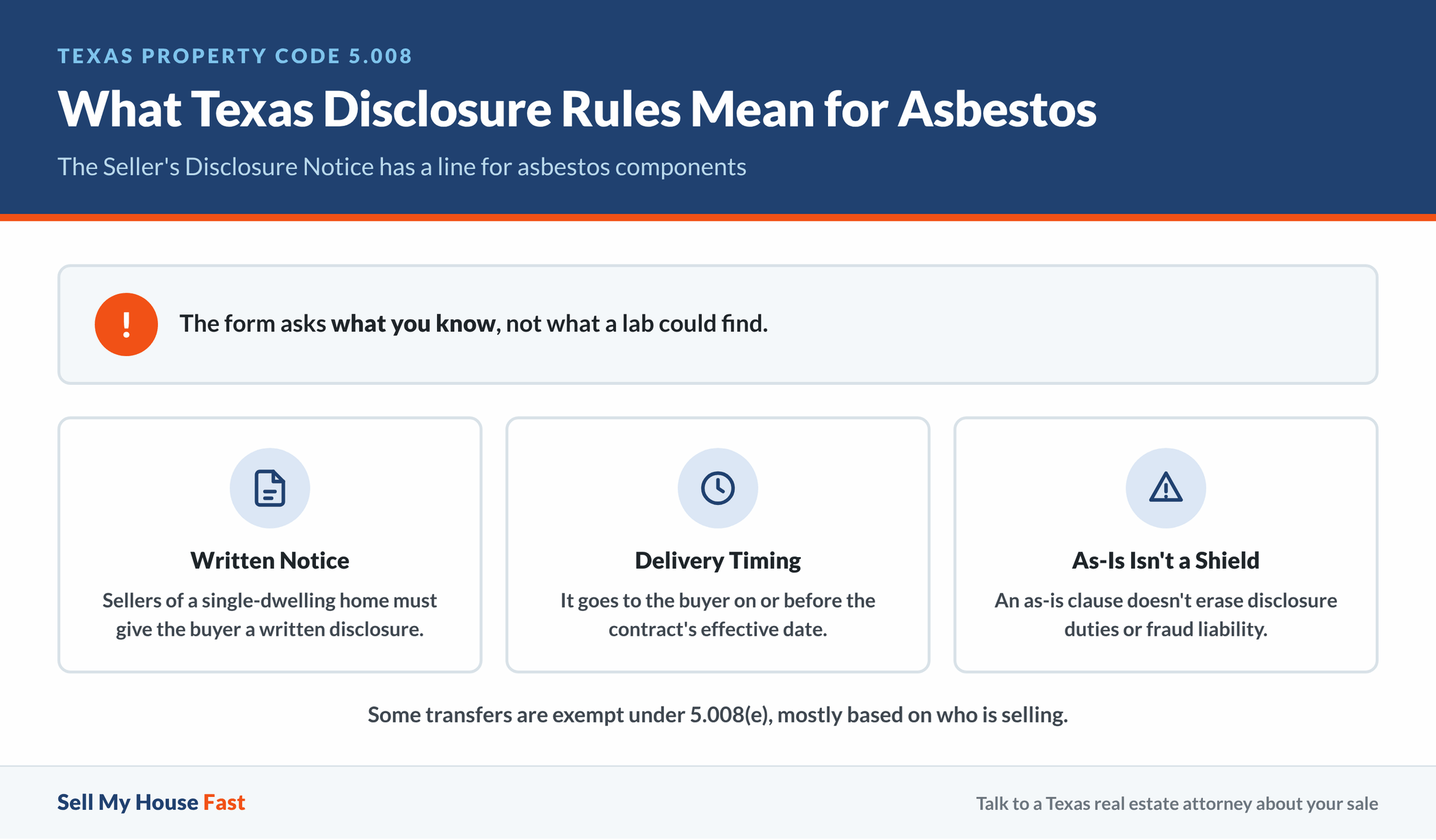
Sellers often believe that if the asbestos has never caused a problem, it doesn’t belong on the paperwork. The Seller’s Disclosure Notice includes a checkbox line for “Asbestos Components,” along with a separate question about repairs or treatments made to remediate environmental hazards such as asbestos, radon, lead-based paint, urea-formaldehyde, or mold.
Texas sellers don’t get to skip this part, it’s written right into the statute. Under Texas Property Code § 5.008, sellers of residential property with not more than one dwelling unit must provide a written disclosure notice to buyers. The Texas Real Estate Commission publishes the form, and it covers material facts and the physical condition of the property. You can view the current version directly on the TREC website.
Timing is written into the statute too. The notice goes to the purchaser on or before the effective date of the contract binding them to buy.
Here’s where Texas sellers need to read carefully. The disclosure asks what you know, not what a lab could find, so you’re not required to hire an inspector and hunt for asbestos before listing. Knowingly concealing asbestos you’re aware of, though, is a separate matter with real consequences.
Certain transfers sit outside the requirement. Exemptions exist under Texas Property Code § 5.008(e), and they generally turn on the capacity of the seller rather than the condition of the house. A Texas real estate attorney can tell you in one phone call whether your specific transfer qualifies.
One more piece that surprises people: an as-is clause does not erase your disclosure obligations under the statute, nor does it shield you from liability for fraud or active concealment.
Can You Sell a House with Asbestos in Texas?
Yes, and I’d tell you that sitting at your kitchen table with a cup of coffee in front of me. Nothing in Texas law forbids selling a house that contains asbestos.
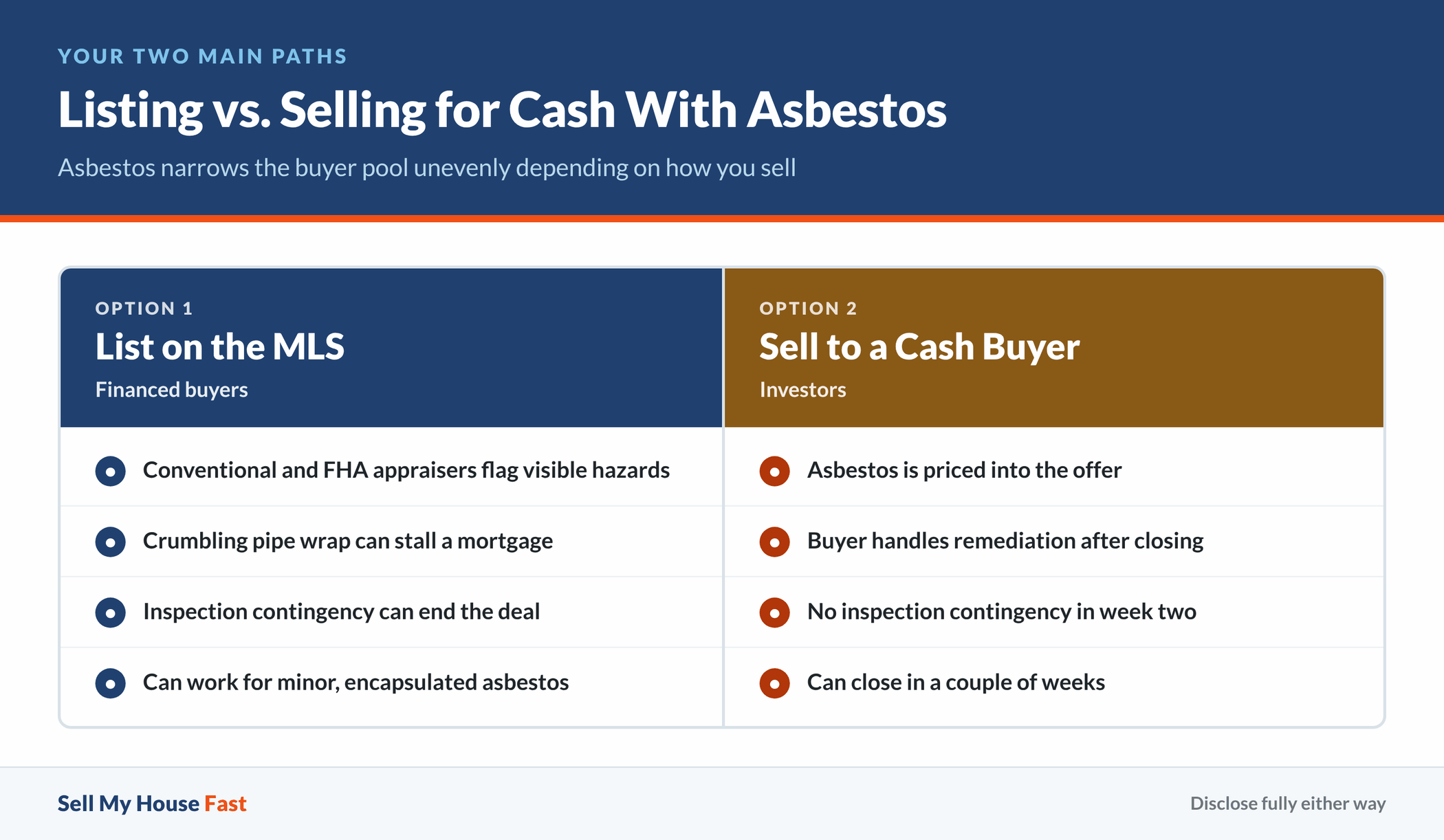
What changes is your pool of buyers and the structure of the deal. Asbestos narrows the field, and it does so unevenly depending on how you sell.
Listing on the MLS puts your Texas property in front of financed buyers. Conventional and FHA loans both involve appraisers who flag visible hazards, and crumbling pipe wrap in plain view can stall a mortgage until someone addresses it.
Cash buyers and investors operate differently. We price asbestos into the offer and handle remediation ourselves after closing.
Selling to an investor who buys in your area means there’s no inspection contingency killing the contract in week two. Companies like Sell My House Fast buy North Texas houses in whatever condition they’re in, asbestos included, and the offer accounts for the work upfront instead of ambushing you later.
Does that mean a retail listing is the wrong move? Not always. I’ve seen a Texas house with minor, encapsulated asbestos in a hot submarket list and sell normally with proper disclosure. The math shifts when remediation runs into five figures or when the material is friable and visible.
My general advice to Texas sellers: disclose fully, price honestly, and pick the sale channel that matches your situation rather than the one that sounds best on paper.
How Does Asbestos Affect a Home’s Value and Sale in Texas?
For years I assumed asbestos knocked a fixed percentage off every property, and that was lazy thinking on my part.
A buyer backing out over asbestos puts you in a tough spot given how slow things are moving. Across Texas, the median days on market sat at 68 days as of late 2026, compared with 39 days nationally. A buyer who walks away over asbestos leaves you staring at months of carrying costs. In Austin as of October 2026, homes averaged 74 days on market and nearly 58 percent of active listings had taken at least one price cut. That’s a market where a flagged hazard gives buyers plenty of room to push.
A $6,000 abatement bill damages buyers proportionally differently by metro. Dallas home prices rose 7.8 percent year over year through October 2026, with a median sale price of $461,000. Houston moved the opposite direction over the same stretch, down 5.5 percent to a median of $330,000. A seller in Houston feels the squeeze harder, since the same remediation cost eats a bigger slice of a softer sale price.
Appraisers generally won’t deduct for asbestos that’s intact and undisturbed.
Buyer psychology does more damage than the material itself in most Texas transactions. Mention asbestos to a first-time buyer touring a Richardson split-level and you’ll watch the enthusiasm drain out of them, even when the only issue is sealed floor tile in a laundry room.
Something I keep seeing: Texas sellers who get one scary quote, panic, and slash their list price by far more than the quote. Get the number first. Then decide.
What Does Asbestos Removal Cost Texas Homeowners?
A seller in Tyler quoted me a $40,000 whole-house abatement estimate she’d received over the phone.
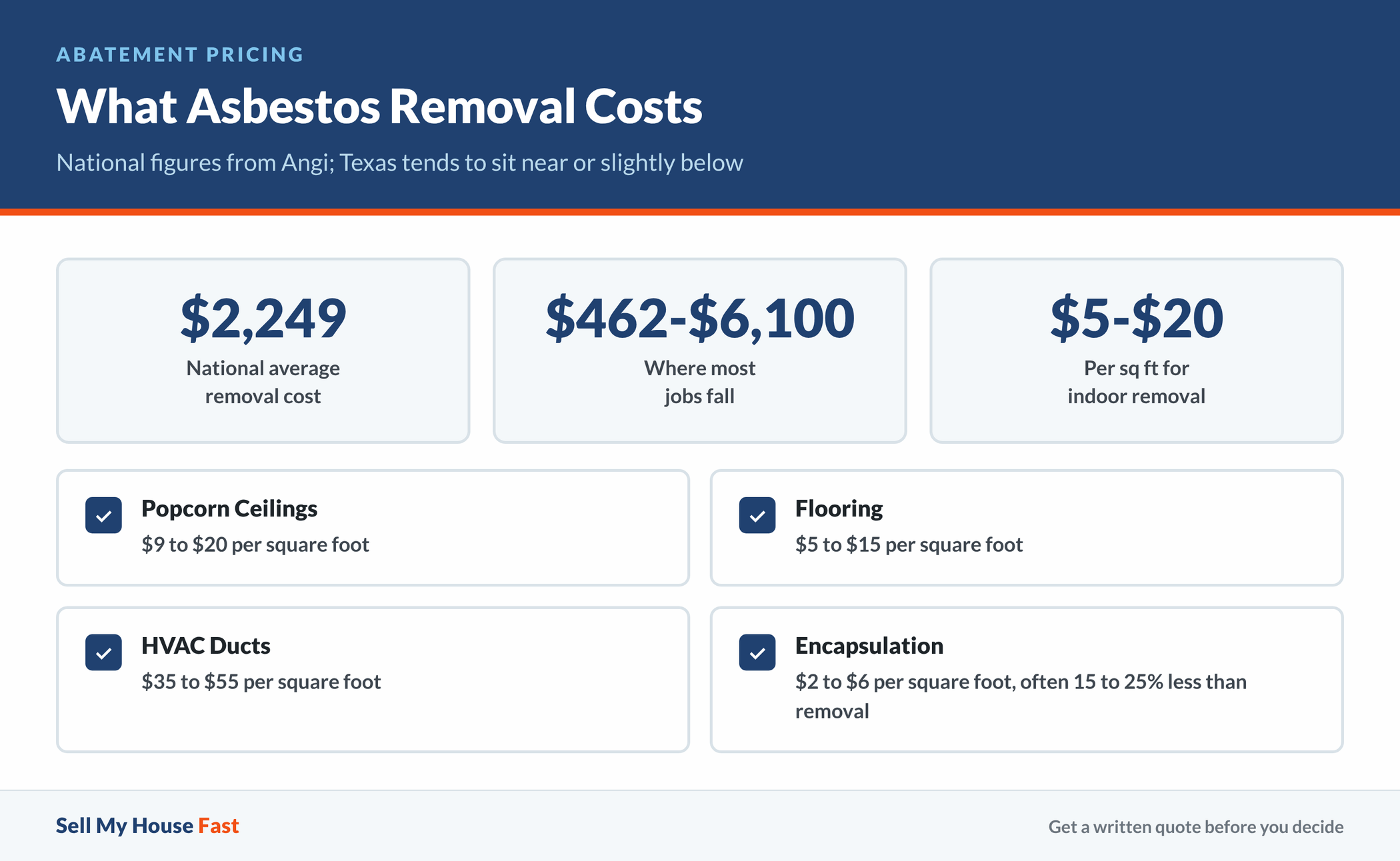
Residential abatement pricing lands in a wide band. Angi’s reported national average for asbestos removal is $2,249, with most jobs falling between $462 and $6,100, and indoor removal running $5 to $20 per square foot. Texas pricing tends to sit near or slightly below those national figures, since labor and disposal costs here run cheaper than in coastal states.
Specific materials carry their own price tags. Popcorn ceilings run $9 to $20 per square foot, flooring $5 to $15, and HVAC ducts $35 to $55. Exterior work on asbestos siding or roofing climbs higher because of scaffolding and the volume of material heading to a landfill.
Don’t overlook encapsulation. Sealing asbestos in place instead of removing it costs $2 to $6 per square foot, typically 15 to 25 percent less than removal. Encapsulation works when the material is stable and won’t be disturbed, and plenty of Texas buyers accept it.
Now the regulatory piece, because it surprises Texas homeowners. The Texas Asbestos Health Protection Rules don’t apply to a single private residence or an apartment building with four or fewer dwelling units. Licensing through the Texas Department of State Health Services governs work in public buildings. You can read the program details on the DSHS asbestos FAQ page.
No. A licensed contractor documents the work, and that paperwork becomes an asset when a Texas buyer asks what was done. Homeowner DIY abatement with no records is worth almost nothing at the closing table.
Before you write a check for any of it, run the numbers against what the repair buys you. Spending $12,000 to abate asbestos in a Texas property that might sell for $18,000 more afterward is a thin margin once you add carrying costs and commission.
Can You Sue for Not Disclosing Asbestos on a Texas Property?
Hide known asbestos from a buyer and you can end up defending a lawsuit two years after you’ve already spent the money from the sale. That’s the part that keeps Texas sellers up at night, and it should.
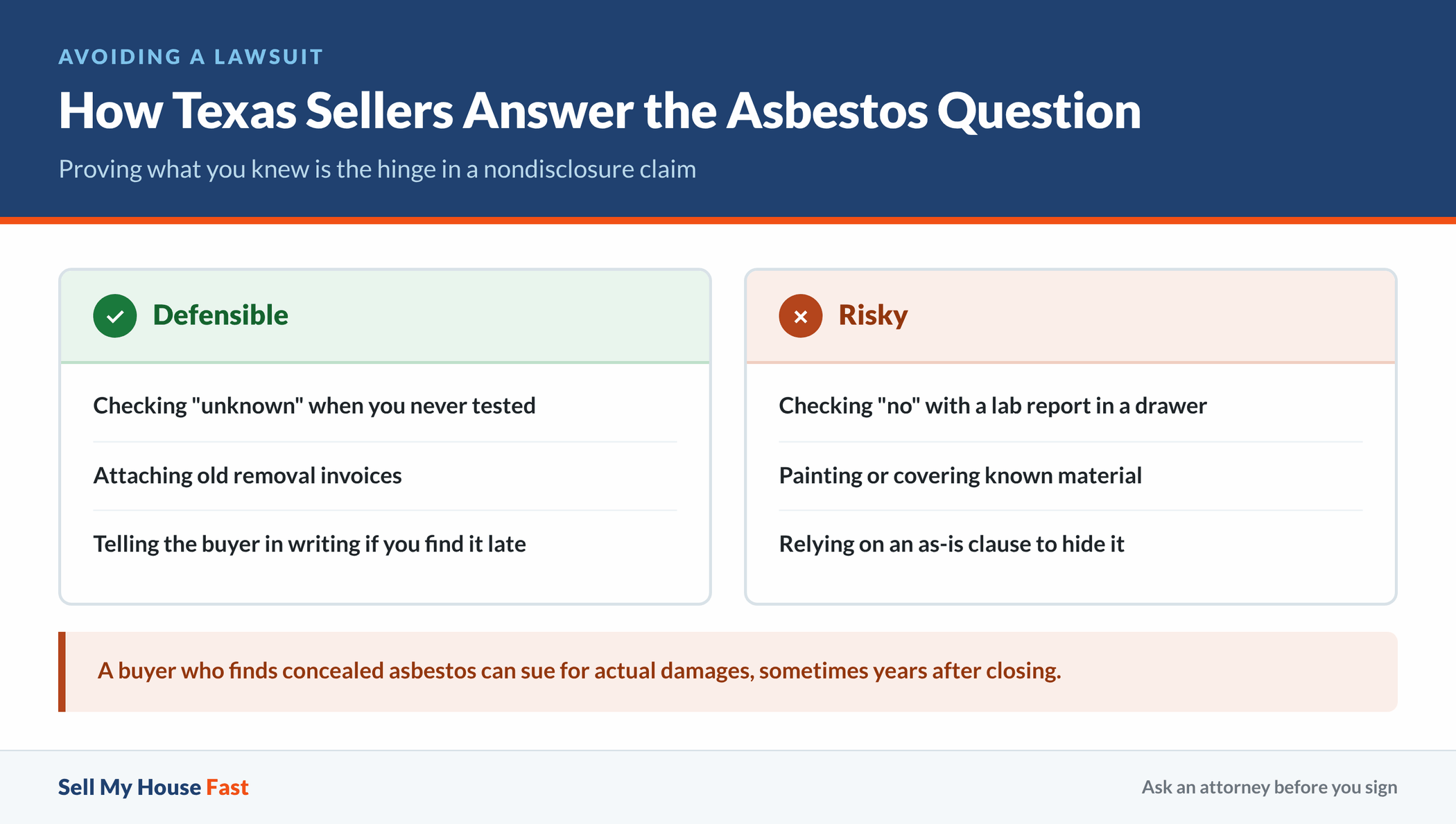
The disclosure form itself warns you: under Texas law you’re required to disclose all known material facts, defects, needed repairs, and adverse conditions, and failing to do so may result in legal liability. A buyer who discovers concealed asbestos can pursue claims for actual damages, and Texas consumer protection law gives attorneys additional avenues depending on the facts.
Hiring an expert, the buyer documents the asbestos, establishes that you knew about it, and asks a court for monetary damages covering remediation plus whatever else the attorney can support.
Proving knowledge is the hinge. A seller who had an asbestos inspection in 2019, got a positive result, then checked “no” on the form in 2026 has a serious problem. A seller who genuinely never knew is in far better shape, which is exactly why “unknown” exists as an answer on the Texas disclosure notice.
Use it when it’s true. Checking “unknown” on asbestos components is honest and defensible if you’ve never tested and never been told. Checking “no” when you’ve got a lab report in a drawer is a different act altogether.
An heir in Seguin called me about her mother’s house after the mother moved into assisted living. She’d found a 1980s contractor’s invoice in a kitchen drawer referencing asbestos tile removal in two rooms. We told her to attach the invoice to the disclosure; the documentation actually helped, because it showed part of the problem had already been handled properly.
Texas sellers worried about exposure should spend an hour with a real estate attorney before signing anything.
Frequently Asked Questions About Selling a House with Asbestos in Texas
Should I Buy a House with Asbestos Shingles?
Asbestos shingles on the roof or siding are among the least worrying forms you’ll find, because the fibers are locked into a cement matrix and don’t release unless the material gets cut, broken, or power-washed. Plenty of Texas homes wear them and have for sixty years without incident. Price the eventual replacement into your offer, leave them alone in the meantime, and hire someone licensed when the time comes to take them off.
Do I Have to Test for Asbestos Before Selling My Texas House?
No state rule requires testing before a residential sale here. The disclosure form asks about your knowledge, not about lab results you never ordered. Testing is still worth considering if you suspect something, since walking into negotiations with facts beats getting blindsided by a buyer’s inspector in week two.
Will a Mortgage Lender Refuse to Finance a Texas Home with Asbestos?
Financing usually goes through when the asbestos is intact and not visible to the appraiser. Problems arise with deteriorating material in plain sight, like crumbling pipe wrap or damaged ceiling texture, because an appraiser may call for repairs before the loan funds. Cash buyers and investors skip that obstacle entirely.
Can I Remove Asbestos From My Own Texas Home?
The state licensing rules described earlier exempt single private residences, so there’s no law stopping a homeowner from doing the work. Whether you should is another question, and my answer is generally no. Improper removal spreads fibres through a house that were previously contained, and you’ll have no clearance documentation to show a buyer afterward.
Does Disclosing Asbestos Automatically Reduce My Sale Price in Texas?
Not automatically, though it does change who shows up. Buyers who want a move-in-ready house will discount heavily or walk; buyers who renovate anyway treat asbestos as a line item. The size of the adjustment tracks the scope of the material and the strength of your local Texas submarket, not some fixed percentage.
What If I Discover Asbestos After I’ve Already Signed a Contract?
Tell your buyer and your agent immediately, in writing. Late discovery handled openly is a renegotiation; late discovery concealed is a fraud claim waiting to happen. Most Texas contracts have mechanisms for addressing newly discovered conditions, and your attorney can walk you through the options.
Is Asbestos Treated Like Lead Paint in a Texas Sale?
They’re related but governed differently. Lead-based paint carries a federal disclosure requirement with its own pamphlet and acknowledgment for homes built before 1978, while asbestos shows up on the state disclosure notice as a condition you report based on what you know. Both belong on your paperwork for an older Texas property.
How Fast Can I Sell a Texas House That Has Asbestos?
A direct sale to an investor can close in a couple of weeks, since there’s no lender, no appraisal, and no inspection contingency to clear. A traditional listing takes considerably longer than a clean house would in the same neighborhood, because you’ll cycle through buyers who back out after the inspection. Your timeline depends far more on the sale channel you choose than on the asbestos itself.
If you’ve got a Texas property with asbestos and you’re not sure which direction makes sense, I’m glad to talk it through with you. Sometimes the right answer is a licensed abatement crew and a normal listing, and sometimes it’s a straight cash sale where you hand us the keys and we deal with the material ourselves. Either way, you can reach out to Sell My House Fast and get a real conversation about your options. No pressure, no obligation, and no charge for an honest opinion.
Selling an Older House in Dallas-Fort Worth
Plenty of homes across Dallas-Fort Worth went up before builders stopped using asbestos, so this question comes up a lot here. Realtor.com’s October 2026 report put the median time on market for DFW homes at 62 days. A house with a known asbestos issue often sits longer than that. If you’d rather not wait, a direct sale lets you pick a closing date that works for you.
Talk With Us About Your Asbestos House
If you’ve got a Texas house with asbestos and you want to see your options, contact Sell My House Fast for a no-obligation cash offer. You can also fill out the short form below, and we’ll get back to you.